













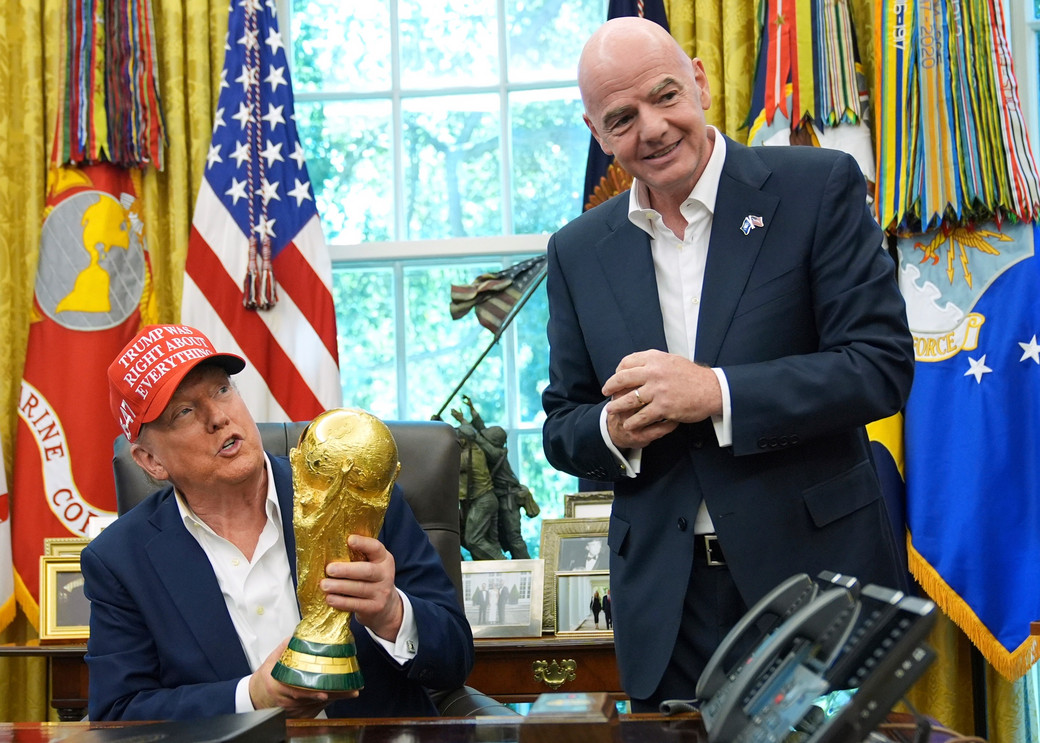






The 2026 FIFA World Cup has become less of an international soccer championship and more of a proxy for political disagreements. In the recent Round of 32 match with the USA playing against Bosnia and Herzegovina, the USMNT striker, Falogun Balogun, received a red card that was later overturned. Historically, only two red cards have been overturned, the most recent one dating back to 1962. The scarcity of red cards being overturned in this tournament sparked great controversy not only because it was unprecedented but because of the political involvement behind it. Following the overturning of the red card, it was made known to the public that President Donald Trump called the FIFA World Cup President, Gianni Infantino, personally claiming,
“I didn’t think it was a foul…I thought it was two great athletes that crashed each other and got entangled,” said Trump.
Infantino responded, stating that “I explained that there was an ongoing legal process involving FIFA’s independent judicial bodies and that the case would be decided in due course by the competent bodies,” said Infantino.
While there was no confirmed evidence that there was a causal relationship between Trump’s phone call and the red card, it has certainly caused severe global backlash as well as strong disputes over sports integrity. Although the phone call itself did not create political polarization, the situation eventually became politically polarized because of the people’s divergent perspectives. The polarization is especially seen between USMNT fans and political observers. Many fans welcomed Trump’s call as it “indirectly” led to Balogun’s participation in the following game. However, other political observers in disagreement claimed the phone call to be executive overreach and unethical.
Additionally, this happens to be one of many situations of political polarization within the World Cup. Due to political tension with Iran and the US, the national government forced Iran to move their training location to Mexico. Furthermore, the US government revoked ticket allocation for the Iranian Football Federation, prohibiting groups of fans from entering. While Homeland Security Secretary Markwayne Mullin publicly admitted, “I was so happy when we were able to pull their visas,” the Iranian Football Federation responded by stating, “The fact that [Mullin] openly celebrates Iran’s elimination says far more about him than it does about our team. It reflects a level of pettiness that cannot even tolerate the presence of a football team competing on the world’s biggest stage.”
While the World Cup serves the purpose of showcasing professional soccer players, it has become a greater platform for national governments to defend their nations and assert political influence. Although it has been more prominent in the recent championships, it has also been seen historically.
Back in the 1970s in Argentina, there was a period known as the “Dirty War.” Essentially, the current military regime hunted down anyone considered a political opponent. During this time, about 30,000 people were forcibly disappeared and taken to detention centers where they were tortured or even killed. So, when Argentina became the host country of the World Cup in 1978, the regime used it as a way to shift any global attention from domestic human abuses towards an exciting image of the game. In the domestic stage, Argentinian soccer fans’ patriotism was used to increase the regime’s domestic popularity. While the propaganda succeeded short-term, it ultimately failed a few years after the tournament and Argentinien democracy was restored. Although this is an example of propaganda, the polarization exists within the people of Argentina. While supporters of the regime remained as Argentinien soccer fans, opponents were placed in detention centers and tortured while the rest of the world was happily cheering.
Overall, the 2026 FIFA World Cup has been a constant spark of excitement for many fans. Although many wish to focus their attention towards supporting their favorite team and watching the games, it is difficult to forget the political aspect behind the international stage. The Brazilian soccer legend, Pele, once said, “Football is the only sport where you put people together, it doesn’t matter if you are rich, or poor, or black, or white. It is one nation. This is the beauty of football.” Yet, as politics continue to intrude upon the beauty of this sport, the question that remains is whether this sport will continue to be respected with integrity or become a battlefield for political polarization.