
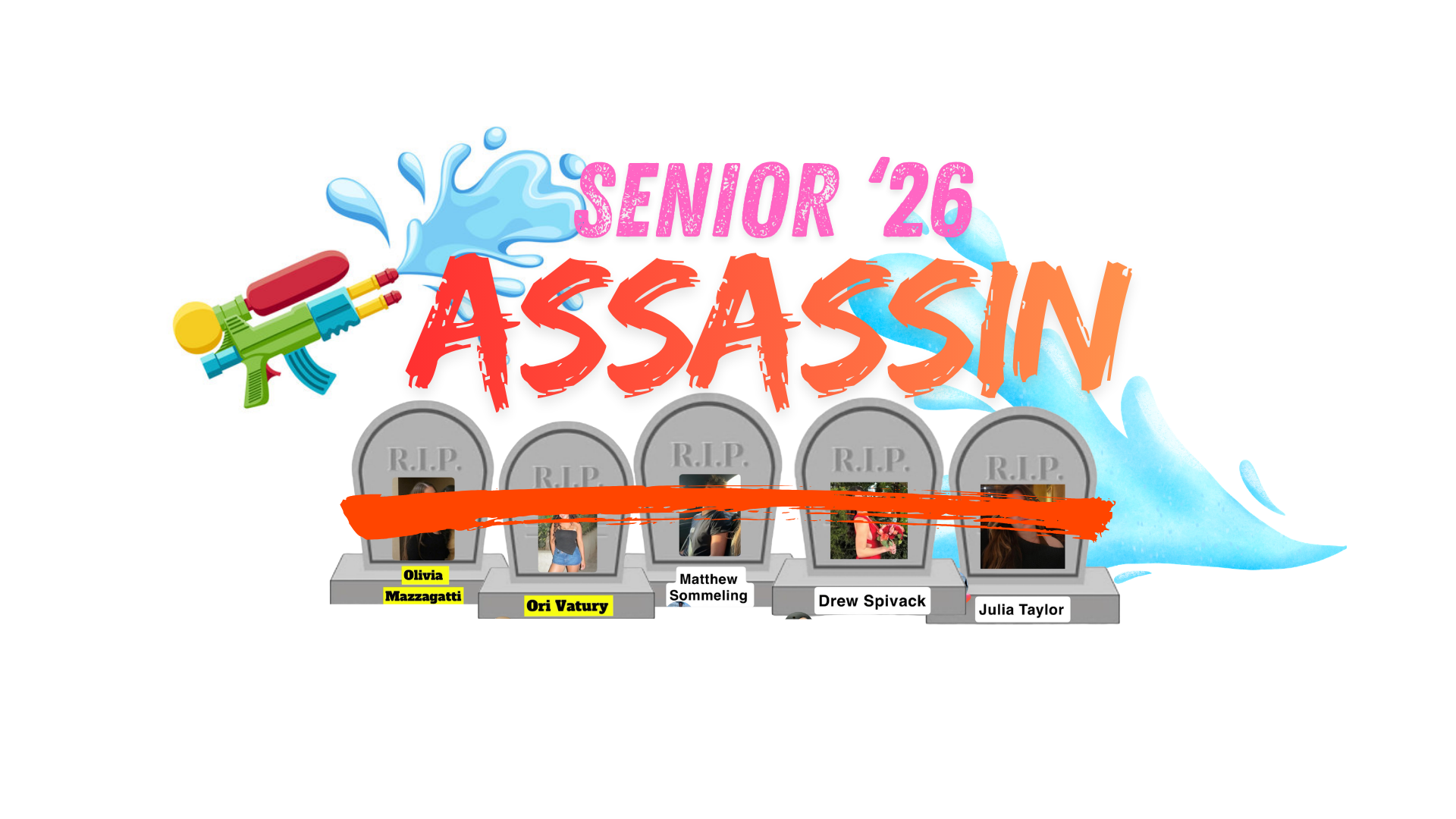
Behind the scenes of Senior Assassin



Every spring, a different kind of energy fills the hallways. The bell rings, and instead of heading home, students scatter across town. They duck behind cars, sprint across lawns, and hide in bushes with one goal in mind: eliminate your target before they eliminate you. Addresses get leaked, strangers become teammates, and betrayals happen. Welcome to Senior Assassin — the final rite of passage that marks the end of high school.
Senior Assassin is a schoolwide elimination game for the senior class. Each player is assigned a target whom they must eliminate by shooting them with a water gun. Once a player is out, their target becomes the shooter’s new assignment, until only one person remains. For an elimination to count, the shooter must record a video of the kill, which is then posted on the Instagram page for everyone to see. The last person standing takes home the prize pot, funded by each player’s entry fee. This year, over 120 seniors paid a $15 fee to enter, making the first-place prize $800, won by Madison O’Mara (’26). Sophia Nikiforova (’26) took home second place, receiving $400, and Lukas Ortega (’26) won $250 in third.
However, every game comes with rules. Players can only make a move when their target is outside a designated safe zone. Eliminations cannot occur at school, in religious buildings, at dance recitals, or at the JCC. Kills must happen while the target is out of a moving car, and this year the rules specified that the car must be parked, not just stopped.
This year’s game also got a technological upgrade. In previous years, the student running the game managed eliminations and assignments through a chaotic Google Sheet. This year, organizers Brad Hendricks (’26) and Rachel Pennock (’26) switched to a dedicated app called Splashin’. Through the app, players simply sign up, enter a game code, and Venmo $15 to the organizers for the prize pot.
But organizing the game is never easy, especially when the organizers are playing it themselves. When elimination videos are unclear, it falls on the organizers to decide whether the kill counts.
“The biggest challenges were definitely people not respecting the decisions that we made, because at the end of the day, people are bothered, people get mad, and it’s opinion-based,” said Hendricks.
Organizers also implemented new safety rules this year based on incidents from the previous year. After players disrupted a dance competition last spring — causing someone to call the police — the JCC and dance recitals were designated as new safe zones for this year’s game.
Despite the stress, the consensus among seniors is clear. Senior Assassin is about more than just the prize pot as it brings the senior class together in unexpected ways. Classmates who barely knew each other teamed up to take down a mutual target and made unforgettable memories in the final stretch of high school.
“I feel like people talk to each other that wouldn’t be talking to each other beforehand, just to be like, ‘Oh, you know this person? I need to set up this person,'” Hendricks said. “It happened to so many of my friends.”
This year’s game ended with a gesture that captured the spirit of the departing senior class. The last three players standing — O’Mara, Nikiforova, and Ortega — decided to split the prize money and produce a short video montage together instead.
“At the end of the day, it’s really not about the money,” Hendricks said. “It’s more about making the memories.”
For one last spring, the seniors got to be kids again — running through neighborhoods with water guns and chasing each other before the stress of college and the future sets in. Next spring, the class of 2027 will be ready to carry on the tradition.

Of the 520 students in the senior class this year, only about 18% registered to play Senior Assassin. While this percentage may seem small compared to the anticipation the game generates as an annual event, it does not account for the many others who participated online. With constant updates on eliminations in workplaces, neighborhoods, and parking lots, the driving force behind Senior Assassin each year proves to be the readily available information accessible through Instagram.
But, where does all of this information come from?
In the weeks following April 6, the @che_bounty_hunters account posted daily updates on each player via Instagram questionnaires. As the creator of the account, Joseph Kwak (‘26) did not actively participate as an assassin, yet his actions seemingly carried the entire game, influencing the movements of every player.
Only two days after the game began — when Senior Assassin seemed to be the only topic on people’s minds — Kwak sat in his AP Environmental Science class when his friends asked him to create an Instagram account that shared information about each player along with tips to succeed in the game.
“I would do a questionnaire, and there would be 20 people just sending stuff in. The first couple [of] days were nonstop, and I would update the account every 10 minutes,” said Kwak.
Every day, Kwak would post Instagram stories labeled “send in info now” or “new snitching poll,” allowing all students at East — whether playing as an assassin or not – to partake in the game. As people replied to Kwak’s stories with information about their friends’ locations, he would quickly repost it as a new story — with the account now acting as a central hub for constant updates on everyone in the game.
As the account quickly gained over 500 followers, a new aspect of senior assassin emerged: players could now manipulate the game in their favor, since any information they submitted would be reposted for everyone to see. Notably, Abby Callahan (‘26) took advantage of this dynamic and credited much of her success to the strategic loopholes it created.
“One of the days, a girl was planning on waiting outside my house, so my friend put on the Bounty Hunters story that I wouldn’t be going home after school so that I could get home safely. She said that I was going to Starbucks instead,” said Callahan.
Not only did the account allow players to fake their locations, but it also provided a platform for people to trick others about their targets.
“I know there was also a time where someone said I had a person that they actually had so that they could get [that] person out,” Callahan said. “She said I had [her target] so that she could go get him out later that day without him being suspicious of her.”
It is hard to imagine a senior assassin game without the @che_bounty_hunters account. Within the newfound intensity, competition, and chaos that ensued, inside jokes, connections, and entertainment quickly followed. As graduation draws near, Senior Assassin serves as one of the final hurrahs of senior year, and with the help of the account, it became an interactive game for everyone — even for the people who prefer not to be followed home or chased down the street.
In her five years of teaching, East’s Culinary Arts teacher Diane Fehder, better known as “Chef Di,” has grown accustomed to hearing one recurring topic during class time – Senior Assassin. Between the rumble of clattering trays and the buzz of chatter, discussions about strategy, elimination tactics, and targets have become a normalized part of her classroom environment.
“In the past years, students have been very preoccupied and distracted because of it,” said Fehder. “It was all [about] the students communicating and making strategies.”
Though Fehder doesn’t particularly mind conversation itself in her classroom, she says it’s an issue when it becomes an impediment to learning.
“When I’m demonstrating how to cook something before they go and move into their kitchen stations, they are whispering and not paying attention to what I am talking about,” said Fehder. “I would say watch my demonstration, learn how to cook this, and once you go into your kitchen station, if you work and talk at the same time, I’m fine with it.”
However, as students become increasingly academically focused and classroom distractions have lessened throughout the years, a new concern has emerged for Fehder: safety.
“I think it’s really fun if it’s played the way it’s intended in a safe, fun way,” said Fehder. “What I don’t like about it [is] the safety concerns.”
This ambivalence developed over the years; among the many stories and strategies amassed, a particular few have raised flags for Fehder.
“I heard one student saying that someone else was going to hide under a car,” said Fehder. “I was [also] told that last year a student followed another car thinking it was their target and it ended up being like a random human being that called the cops because somebody in the car was following them.”
Because of incidents like these, Fehder believes the game should prohibit any precarious actions involving moving vehicles.
“I think that there should be a rule that you cannot involve vehicles or moving cars, because that’s where the danger and safety [concerns are],” said Fehder. “I just want everybody to be safe, basically.”
Despite these concerns, Fehder ultimately understands why students enjoy the tradition. However, she also disagrees with some strategies used in the game.
“I also don’t like that they pay each other off to get out and in,” said Fehder. “I think that defeats the whole purpose of the challenge and the game.”
Still, Fehder doesn’t want to strip the excitement from the game; instead, she hopes students will approach Senior Assassin with more safety and responsibility. As long as the competition stays safe – and out of classroom lectures – she’s content hearing the murmurs of strategy discussions over the clattering of trays.