
























East needs to address declining literacy rates


Literacy, which is commonly defined as the ability to read and write, has implications that extend far beyond English classrooms. Strong literacy skills increase access to job opportunities, decrease the chance of crime and can even improve health outcomes. In every interaction — from doctor’s visits to conversing with a neighbor — people rely on their ability to understand others and express their own ideas. Yet, 54% of Americans read below a sixth-grade level, according to a study from the National Center of Education Statistics.
Why are literacy rates declining?
There is no single factor behind America’s low literacy rate; rather, multiple shortcomings are to blame. The rise of artificial intelligence, which many students rely on to write and complete homework, as well as social media, which has been proven to shorten attention spans, certainly contributes to the issue.
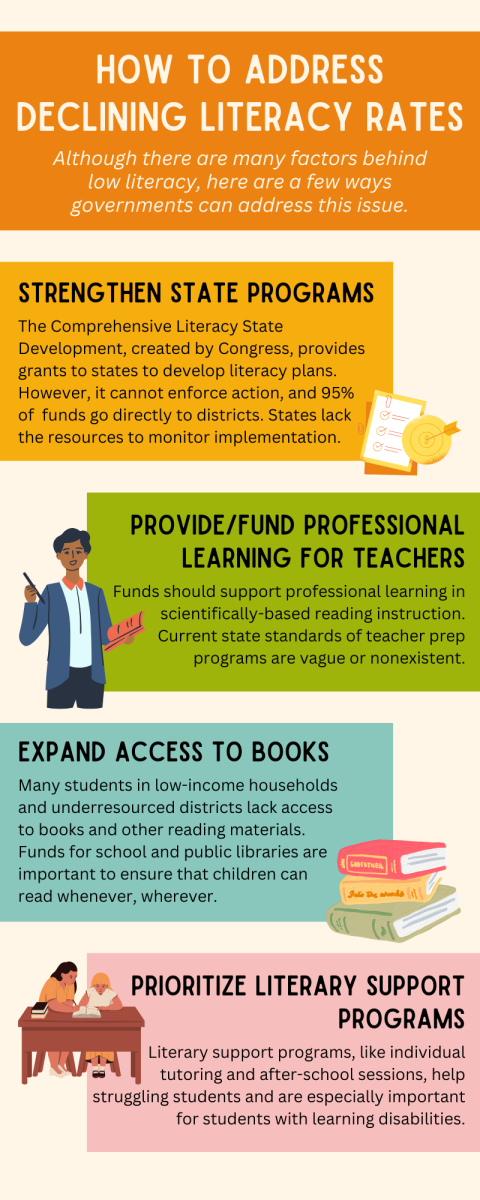
However, structural failures in the classroom, such as the lack of training that teachers receive to teach reading, the inaccessibility of reading resources for many schools and low academic standards underlie schools’ declining literacy rates. While scientifically-backed reading instruction, like phonetic awareness, is proven to increase student comprehension, many school districts do not require teachers to learn these skills or cannot afford to send educators to professional development programs. And because reading skills compound over time, students who fall behind in kindergarten or elementary have little chance of catching up later on.
COVID-19 only exacerbated the impact of these problems as students lost learning time due to school closures. According to McKinsey & Company, the pandemic left students as much as four months behind in reading.
However, the decline began even before the pandemic hit. American students’ reading scores peaked a decade ago, according to Martin West, the professor of education at the Harvard Graduate School of Education, and have been dropping ever since. In order to remedy nationwide literacy gaps, solutions need to address these systematic barriers. Low literacy rates are cyclical: children of low-literate adults are 72% more likely to experience low literacy themselves.
Why is literacy important?
The necessity of literacy in school is clear to many: subjects like English and social studies, which rely heavily on writing and reading comprehension, require students to know how to understand complex texts and express their own ideas. Literacy is also important in subjects not typically associated with reading and writing, such as mathematics and science, where students need the ability to comprehend multi-step problems.
Beyond higher education, literacy skills increase access to higher-paying jobs. The average income of an adult who reads at a sixth-grade level is $63,000, compared to just $48,000 for adults who read at a third- to fifth-grade level. Besides financial well-being, low literacy skills impact public health. Health literacy, which is defined by Healthy People 2030 as “the degree to which individuals have the capacity to find, understand and use information and services to inform health-related decisions and actions,” is critically low in the United States. This can impact individuals’ ability to communicate with doctors, understand medication labels and participate in medical decisions.
At its core, reading for enjoyment is a key way to support mental and emotional well-being, creativity and improve overall quality of life. Studies have shown that children who began reading for pleasure at an early age showed fewer signs of depression and anxiety in adolescence, as well as improved focus.
Tackling low literacy rates is not an educational necessity, but it is a social, physical and economic imperative. Any solutions implemented today will have cascading effects that strengthen future generations as a whole.
Proposed in 1966, Jack Brehm’s psychological “Reactance Theory” explains our intrinsic draw toward personal “forbidden fruits.” He posited that perceived threats or restrictions to one’s freedom of choice motivate us to protect our autonomy by rejecting the task imposed on us. When we’re “forced” to learn or do something we might have otherwise enjoyed, we push back — attributing our action to that external pressure rather than internal enjoyment. Once that pressure is removed, our desire to do it often disappears entirely.
Literature’s defining identity lies in its nature as an art form. But when our first exposure to books in elementary school is via mandated reading logs or prerequisites for in-class quizzes, the external pressure imposed by teachers and parents inhibits the vast majority of children from “falling in love” with reading the same way they would with music, dance or film.
Hence, the failure of President George W. Bush’s No Child Left Behind Act (NCLB), which passed Congress with overwhelming bipartisan agreement, encapsulates the pitfalls of the “teach the test” methodology. What began as an initiative to strengthen American education eroded into something that systematically drove students away from learning.
The NCLB was primarily created in response to the growing concern that the American education system was no longer internationally competitive; its goal was to increase the federal government’s role in holding schools accountable for the success of their students — focusing especially on increasing achievement within statistically underperforming groups, such as special education, poor or minority students and English language learners. To do this, states were required to test students in math and reading from grades three through eight and once in high school; all states had to bring their students to a “proficient level” — a standard that was set by and thus differed among each state. If a school missed its state’s annual achievement targets, a cascade of increasingly consequential sanctions — from in-district student transfers to entire federal shutdowns of schools — could be set in motion. Thus, the imposition of the NCLB’s concessions led to a disproportionate amount of time and attention being turned toward standardized testing to meet these markers.
This priority shift led to systemic disengagement with the material being learned and tested. Focusing too heavily on punitive measures and statistical metrics, the NCLB narrowed curricula and promoted a “teach the test” culture. In order to prioritize subjects being tested, vital disciplines like social sciences and the arts were put on the back burner. Students were taught to learn in order to succeed on these tests, only to discard the information shortly after, instead of fostering a deeper interest in learning. The NCLB thus acted as a catalyst for the degradation of student interest and engagement in the literary arts, presenting reading as an obligatory, purely scholastic task, rather than a pleasurable—and incredibly necessary—form of artistic expression.
Literature is a microcosm of the social world; it acts as a mirror of the human experience, tracing ancient thoughts and enduring beliefs. The systemic corrosion of reading and writing from a profoundly human and necessary form of personal expression will continue to cheapen innovation and stifle creativity for our posterity.
Since I can remember, books have always been a constant in my life. They decorate my bedroom shelves and live on my bedside table. The picture books I read as a young girl evolved into ones with chapters and hundreds of pages. “Pinkalicious” and “Fancy Nancy” turned into “Harry Potter” and “The Hunger Games”, all of which led to my love of reading today. Books are an avenue for me, and others, to dive into hundreds of stories and momentarily escape into another world. I became an avid reader because I had the freedom of choice.
I believe that English teachers at Cherry Hill High School East should be implementing a choice book requirement for students to read once a marking period. Students are more likely to connect with books that pertain to their interests. Ultimately, allowing students the opportunity to choose a book can increase their connection to reading. This would be highly beneficial for participation and engagement in English classes and may also encourage more reluctant readers to begin their own reading journey.
Of course, there would need to be parameters placed regarding the appropriateness of choice books. For example, an identified page requirement and a list of genres can be made by English teachers. These guidelines may vary depending on the year and course level. To ensure fairness, teachers would collaborate to make sure that all students in the same grade and level are held to the same expectations. Teachers, at the end of each marking period, can hold students accountable for their reading by having them present the information through a written summary, a Google Slides presentation or a video. Any of these options provides autonomy for students by letting them choose how they want to display their understanding of their book. This, too, will increase student engagement in English classes.
Having a choice book requirement would also foster a stronger community of readers in the school. Students may naturally begin to recommend books to one another, furthering book discussions outside of the classroom. Additionally, having conversations about a choice book can facilitate relationships between students and teachers. These conversations allow teachers and students to gain a better insight into one another’s passions and interests. Both students and teachers may make book recommendations, thus enriching the reading community at East.
A choice book requirement will increase student engagement with reading and, therefore, improve academic skills in other classrooms. Reading more will expand students’ vocabulary, improve reading comprehension, and enhance overall literacy skills. English teachers will not be the only ones observing student improvement.
Overall, English teachers at East should require the reading of choice books once a marking period. This will lead students to become more engaged in reading and active in class discussions. An increase in reading would benefit numerous aspects of a student’s life. When given the opportunity to read a choice book for school, students may even find themselves gathering books on their shelves and bedside tables.
In his posthumously published book, American philosopher George Herbert Mead proposed the theory of symbolic interactionism — the idea that meaning is gained subjectively through interaction and interpretation, rather than being inherent in objects themselves. In our daily lives, we craft personal understandings of the world through these interactions. In reading, every moment we spend annotating — every idea, connection, and interpretation we form — is a moment we spend building personal meaning that translates into enjoyment.
A common argument against annotations is that they break immersion due to their interruptive nature, which disrupts reading flow. However, while this may not be unfounded, it’s unreasonable for us to underestimate the value of an intentional pause; when words tumble on endlessly, a moment to absorb and assess is critical to look beyond surface-level elements. The small pauses of annotating allow students to examine the tiny details — as insignificant as they may be at first glance — and wholly understand the intentions behind them. Every moment we spend interacting with a book allows us to build a much more holistic and personal meaning of it, rather than one built solely through emotion.
However, it’s important to make distinctions between intentional and unintentional annotations. In an academic setting where annotations are assigned, students may find themselves taking notes not out of a desire to grow in their understanding of the book, but out of fear of receiving poor grades.
“When students don’t annotate thoughtfully, they annotate for a grade, or they annotate out of fear,” said Jonathan Blum, an English teacher at Cherry Hill High School East for over 12 years. “When they annotate, they overdo it…They’re so consumed by their own fear that they’re not really thinking.”
Motivation that’s rooted in fear strips annotations of their purpose, ultimately reducing an opportunity for meaningful engagement into a purposeless school assignment. Truly appreciating the worth of a book takes more than just a heedless glance; it takes a dedicated effort of contemplation through annotations, of personally evaluating the material to build personal interpretations — the very aspect that makes literature the conversion of ideas.
“Anytime we watch or read or look or listen to anything or meet a brand new human being, we are building meaning,” said Blum. “We do these things instinctually — instinctively. And that’s a key idea: as you read something, you’re building meaning as you’re going through the book…and that’s an important part of just what it means to be an active, thoughtful person.”
When time is taken to question, investigate, and appreciate the details we initially deem unnecessary, we build a relationship that makes us aware of the author’s intentions and simultaneously builds our personal interpretations. This instance of symbolic interactionism is what truly transforms a book from a static object into a lasting experience.
Mellow light spills over pages. The soft hum of the heater blurs into the background. Ink black words sprawl across your vision, each syllable carrying you forward like a wave ebbing and flowing against a sea shore. You can feel yourself drifting off into this literary current, swept into the waxes and wanes of emotions the author crafted with purpose. Everything is just right: the pace, and the words, and the characters and —
Pause.
You glance to the right and see a stack of lined papers waiting for your attention, topped by a cold, white assignment sheet titled: “Notes.”
Right.
In reading, one of the most enthralling experiences is full immersion. This state allows readers to connect deeply with the author’s intentions — the right emotions felt just as intended, characters so vivid that it feels like they’re present, and plot twists so compelling they make you chase the next page. In these moments, the reader is most in tune with the author, the text and the emotions the author embeds with each printed word.
The process of notetaking, however, naturally contradicts this favorable flow state. While notes can be a useful tool for understanding the depth of literary elements more deeply — and in some cases, lead to greater enjoyment — it’s unreasonable to equate these annotations with engagement. For students pressured to follow rigid reading schedules and intense annotation deadlines, notetaking transforms what was once an enjoyable pastime into a chore. In the end, rather than promoting a greater comprehension of a book, it ultimately diminishes the motivations that a reader has to enjoy a book.
When students reflect on their high school experience, they likely won’t want to look back on wasted hours spent writing pages of notes; instead, they want to reminisce on moments of an uninterrupted reading experience — of being able to read, understand and analyze without the pressure to fill pages. By stripping students of immersion, teachers not only waste time assigning work that many students will complete without genuine thoughtfulness, but also disrupt the mood and rhythm of a book — two elements that are crucial for novels and poetry in building meaning and enjoyment.
Engagement through forced analysis can destroy engagement through feeling — the emotional resonance that the author deliberately crafts. If students are unable to truly immerse themselves in the book because they have to pause every other page, how will they enjoy or experience a book as it is meant to be read?