














From Cherry Hill East’s numerous culture clubs to the everyday passersby on the street, diversity is one of the defining features of Cherry Hill. One of the most powerful ways this cultural variety is preserved and celebrated is through the community’s language schools. In this story, Eastside explores three diverse language programs that help keep multiculturalism thriving in Cherry Hill.
Cherry Hill Huaxia Chinese School
Every Saturday afternoon, the halls of Henry C. Beck Middle School fill with the sound of Mandarin lessons, the melodies of the guzheng, the shouts of Kung-Fu students and the chatter of hundreds of children and parents. This is the Cherry Hill Huaxia Chinese School (CHHCS), a nonprofit organization aiming to share the Chinese language and culture.
Founded in June 2003, CHHCS follows an extensive curriculum offering nine levels of Mandarin instruction and elective courses such as painting, dancing, martial arts and Chinese Chess.
For graduate student and volunteer Shulan Ling (‘29), it’s the assortment of electives that enables the greatest sense of connection with her peers.
“By taking these electives, it’s more free than just sitting, listening to a teacher’s lecture,” Ling said. “You can actually talk to other students [who] have similar cultural backgrounds, and you can learn about culture from the teachers.”
For fellow volunteer Jessica Jen (‘29), what she finds most impactful about the school isn’t the language classes, nor the electives. It’s the people. CHHCS’s student body comprises both heritage and non-heritage learners, for whom they provide Chinese-as-a-Second-Language classes. This allows for a degree of ethnic diversity in the community, shifting CHHCS from being just an environment to learn about the Chinese language and culture to a space where students can also learn about each other.
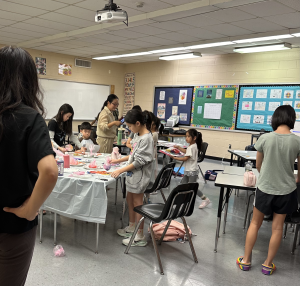
“When we see people of other cultures, we’re learning about each other at the same time. With electives and those Chinese classes, we can actually get to connect with a lot of new people with similar heritages or backgrounds [too],” Jen said. “That actually helps us build identity because we’re able to…connect our experiences with their experience and realize how connected everyone actually is, and that really helps build a stronger sense of community.”
CHHCS hosts a variety of events year-round that help Chinese culture thrive outside of the classroom. While many of the smaller individual events are held by elective teachers, the biggest community events culminate at the annual Spring Festival Gala in February, drawing hundreds to celebrate through the various class performances. From the lively sounds that fill the halls to the friendships made in the classroom, CHHCS ultimately leaves students with more than just knowledge—but rather, a place of cultural community where both heritage and non-heritage learners can return to connect and learn together.
Korean School of Southern New Jersey
On weekends, students of the Korean School of Southern New Jersey (KSSNJ) gather to learn more than just a language.
The Korean School of Cherry Hill was founded in 1979 and later rebranded as the Korean School of Southern New Jersey in 2009. Over the past four decades, KSSNJ has developed a curriculum that connects students with their heritage through classes in language, history and culture. For Allison Kang (‘26), the student council president of the KSSNJ, this environment has been crucial in shaping her cultural identity.
“Regular high school and the regular American education system [don’t] teach specifically about Korean culture,” Kang said. “So getting that chance and opportunity to learn something about Korean history in that kind of environment…from someone who’s experienced it and has ancestors who experienced it firsthand—I feel like that really helped with forming my own identity.”
In addition to academic classes, KSSNJ offers electives that allow students to explore creative, cultural interests. There are classes teaching the arts, such as Korean traditional dancing and Korean drumming, that give students a hands-on way to engage with their culture. Kang herself participates in the school’s dance program.
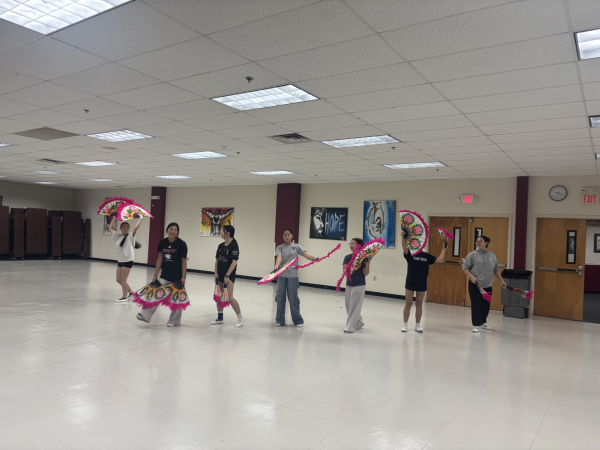
“[Not only] just being involved with…the educational aspect, I think learning about actual Korean dances has really helped with my relationships with other Koreans within the community,” Kang said. “I feel that [being part of a dance team is] really strengthens the bond between all of us.”
Several times a year, these artistic programs are brought beyond the school’s walls, with students often performing and competing across the tristate area. For the students, these events supply them with a platform to showcase abilities developed through classes. For others, it nurtures greater cultural appreciation among both Korean and non-Korean audiences.
KSSNJ may begin as a place to learn Korean, but every weekend, students might find something more than just language; rather, they find new friendships, an intriguing culture and grounded cultural identities.
“[KSSNJ] definitely helps with forming your own identity because there’s nowhere else that you can really learn this,” Kang said. “You can learn basic [Korean] from your parents, but getting that firsthand experience from a professional dancer or…special guests who literally fly in from Korea, [and] having that space and opportunity—you literally can’t get that anywhere else.”
Kol Ami Hebrew School
In 2022, Eastside reported that over 11,000 Jewish residents live in the Cherry Hill area. With such a large Jewish population, Congregation Kol Ami’s Hebrew School has become an important place of community and education for Jewish students in Cherry Hill.
Kol Ami Hebrew High School is the advanced program for students in grades 8-12 within the Kol Ami Religious School. Since its formal founding in 2022, the religious school has helped students strengthen their cultural identity and reinforce their understanding of Judaism through their K-12 educational system.
Joey Lieberson (‘26) has grown up in the program, first as a young student, and now as a student-teacher for the underclassmen and a volunteer for the school. For her, Kol Ami is more than just a place of worship.
“I’m very much there for the culture. [Kol Ami] basically gives me the space to connect with other Jewish people my age or not,” Lieberson said. In addition to its curriculum classes, the Kol Ami Religious School runs youth groups that help younger students build relationships and experience Jewish life together.
However, Kol Ami doesn’t just enable Jewish teens to interact with their peers, but also with the generations before them. The Hebrew High School’s Gesher program pairs 11th and 12th graders with the congregation’s senior citizens, allowing them to build valuable and meaningful relationships with people outside their age group.
“I became really close with [the senior citizens] and we were able to talk about all things life, all things Jewish, everything,” Lieberson said. “We still have a really great relationship, and I was able to make that intergenerational connection.”
The Kol Ami Religious School also offers students opportunities beyond the classroom to engage in the world around them. L’Taken is a nationwide program where Jewish teens visit Capitol Hill in Washington, D.C. to advocate for causes that matter to their community. Lieberson recalled that some of her best memories at school were from her experience participating in L’Taken with a team of fellow Jews.
As a space of fellowship and a second home for some members of the Jewish community, Lieberson believes that Kol Ami is more important today than ever.
“[Kol Ami is] just a space to be around Jewish people, which is really important especially now when the world is reaping with anti-semitism. It’s really important just to be strong together and talk about how we can face these issues…look at the world together and celebrate our culture.”