

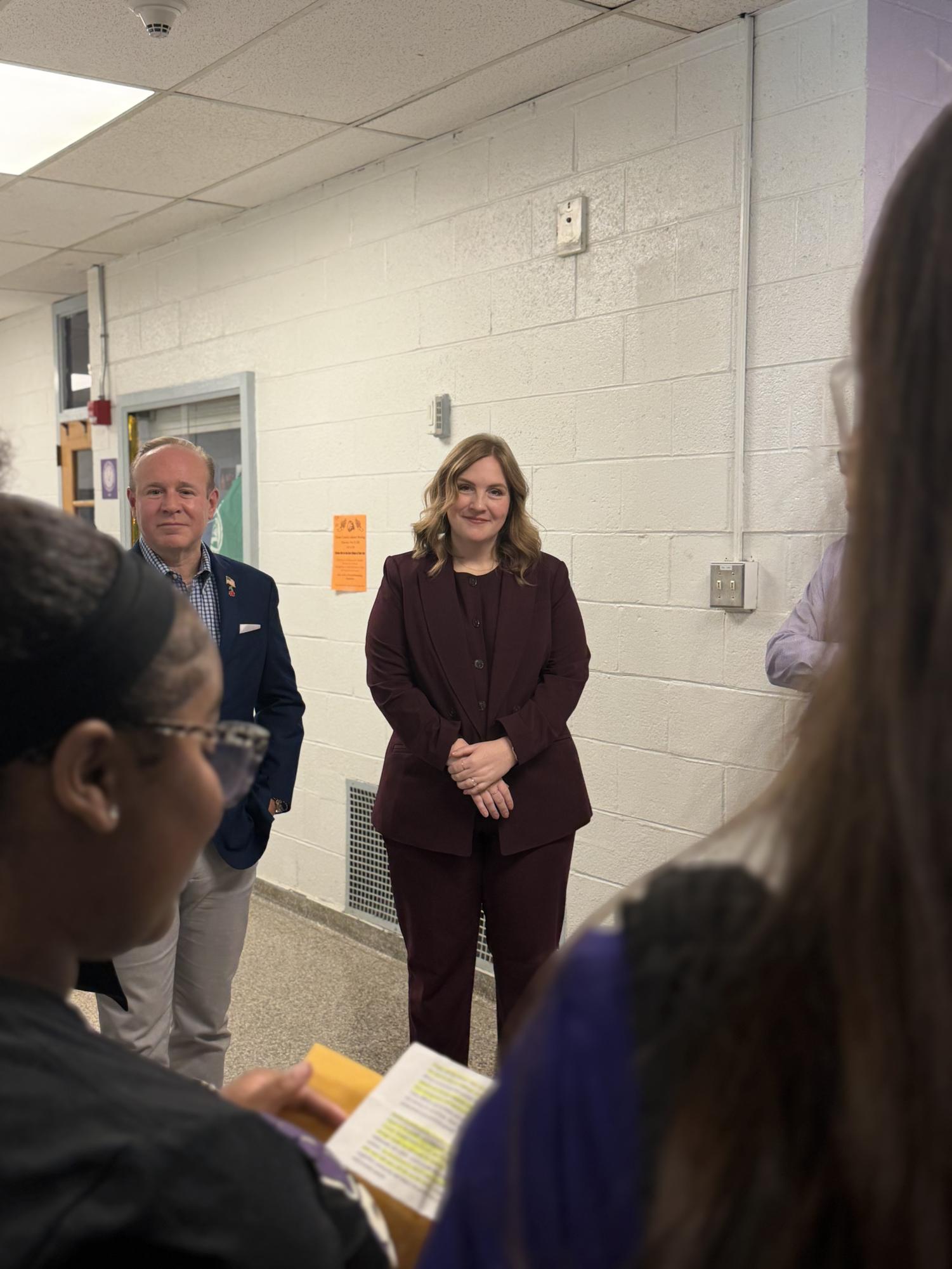
New Jersey Commissioner of Education Dr. Lily Laux visited three schools in the Cherry Hill Public Schools district on May 29, which Cherry Hill administrators organized to demonstrate the importance of restoring district funding. Among those in attendance were State Senator James Beach, Superintendent Dr. Kwame Morton and Mayor Dave Fleisher, along with several Board of Education members and central administrators. The tour began at John A. Carusi Middle School, where Dr. Morton introduced the attendees and explained the purpose of the visit.
For three consecutive years, the Cherry Hill Public Schools district has received reductions in state aid, resulting in a $29 million budget deficit for the 2026-27 school year. Although efforts to minimize the impacts of the budget cuts saved millions, funding remains insufficient to support the needs of students and staff. The in-person meeting with Laux provided an opportunity to showcase the programs and opportunities offered at various Cherry Hill schools.
“We’re hoping to show all the different ways that our students are thriving,” said Board of Education President Gina Winters during the opening remarks. “It’s a story of where we came from, where we are right now, and where we hope to go in the future, and that future depends on adequate funding.”
At Carusi, Laux heard firsthand from students about their experiences participating in and learning from the school community. She also visited the media center, special education classrooms, D-wing, and B-wing, which is currently under construction.
“Our community and parents have really been supportive. They get to see the fruits of this, and they’re loving it,” said Carusi Principal Mrs. Christina Franco regarding the multi-year renovations.
After leaving Carusi, the group took a bus to Joyce Kilmer Elementary School, where they visited the playground and preschool wing. There, Assistant Superintendent Dr. Farrah Mahan introduced Cherry Hill’s preschool expansion program, which will add 16 classrooms across various sites, along with facility improvements such as new playground structures. Laux toured eight of the newly-built classrooms and interacted with preschool students.
At Kilmer, Eastside had the chance to ask Laux her thoughts on the current funding formula and district budget. Presently, state aid is calculated using the School Funding Reform Act, which considers factors such as the cost of education and community wealth. However, recent demographic shifts mean that traditional notions of Cherry Hill being an affluent community no longer hold true. Nearly 25% of Cherry Hill students are economically disadvantaged, and 60% of them attend the district’s Title 1 schools.
“The current funding formula is designed to follow student need. It was a groundbreaking formula when it came into being over 20 years ago,” Laux said. “Now we’re hearing that across the state, it’s no longer working for many districts. So we’re getting ready to look at all of the components that go into it.”
In regard to the likelihood of changing the formula in the coming years, Laux expressed optimism.
“I hope [for that] to be very likely, but making sure that the formula supports all of the students in New Jersey is the goal. I think there’s a lot of energy and recognition that that’s a problem to collectively solve,” Laux said.
When asked if she had an idea of whether or not Cherry Hill specifically would receive more funding, Laux explained that there was no clear-cut answer.
“The short answer to that is not yet. As we talk about the funding formula, we have to make sure it works for every district in New Jersey, and there’s a lot of individual nuances,” Laux said. “But [it’s] really wonderful to see the programs and investments that our community here has already made.”
The last stop of the tour was Cherry Hill High School West, where Laux heard speeches from West students who spoke on their involvement in West’s athletic, student leadership and internship programs. Laux’s tour ended with her visiting A-wing, D-wing, the library and functional vocational program. Following her departure, Morton and the attending Board members expressed optimism about the impression that the district made on the commissioner.
“I thought that she was very authentic and sincere in terms of her desire to learn as much as she can about Cherry Hill Public Schools. There are families, kids and dreams behind every strand of data, so that’s what we wanted to elevate today,” Morton said at the tour’s conclusion. “I think she walked away understanding the Cherry Hill story.”