

Understanding online activism and performative activism


Social media provides a platform for people of all ages to express their viewpoints. It is almost impossible to browse social media without being exposed to the diverse opinions regarding politics, social issues, the environment, and more. In an attempt to spread support for specific causes, influential individuals and organizations use internet platforms to extend their beliefs to huge audiences.
Online activism refers to the use of internet platforms to promote, advance, or raise awareness about specific movements.
Hashtag campaigns are a prominent form of online activism. A specific hashtag is attached to a wide variety of content in support of a campaign. They have been seen throughout social media for decades, including #BlackLivesMatter and #MeToo.
Online petitions are also a popular form of online activism. It involves users putting their virtual signatures on a form to build momentum for a cause. One prominent example is “Justice for Eric Garner,” which was a petition with over 140,000 signatures that managed to get a police officer fired five years after he choked a man to death.
A major form of online activism among younger people is reposting campaigns. An organization or influencer will post an often shocking statistic or image and then encourage followers to repost it on their personal stories. Those who see the secondhand post on their friends’ stories are then inspired to repost it themselves, repeating the cycle. This tactic spreads posts like wildfire, as it gives the post far more reach than just direct followers. Recently, there have been a plethora of reposting campaigns about ICE, the Gaza-Israel conflict, and the Epstein files.
Sometimes, the activist posts evolve into real world action. Particularly impactful messages on social media can engender protests or boycotts. East experienced this during the anti-ICE walkout in February.
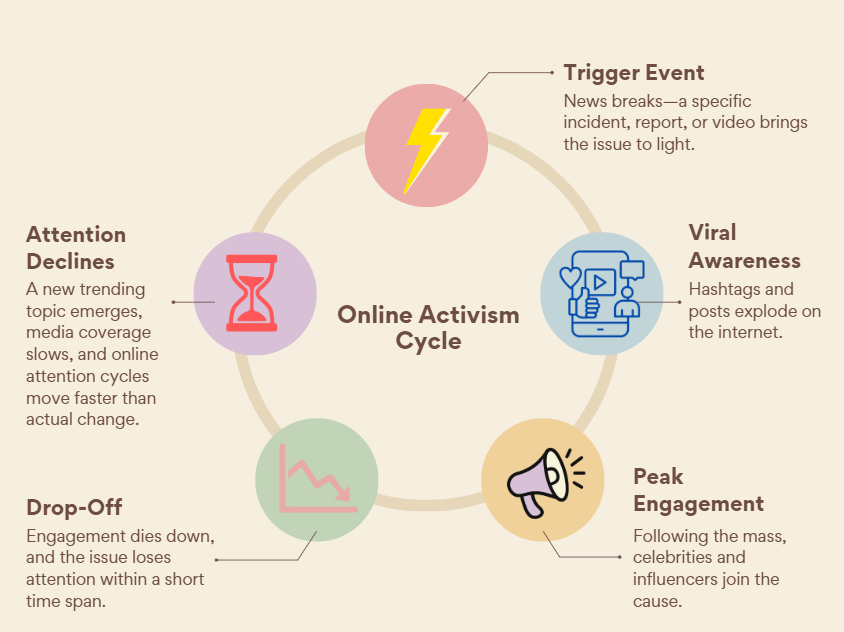
Social media algorithms tend to prioritize short-term engagement over long-term relevance. Consequently, most online movements are only spotlighted for a short period of time, losing traction quickly in the high-speed, online environment. This prevents the vast majority of popular internet causes from resulting in tangible change. The reposting system of spreading awareness also tends to fail, as many of those who participate do so without fully understanding the issues they are promoting. High school students are especially vulnerable to reposting without complete comprehension, as many lack political awareness and are influenced by pressure from peers.
Online activism is a crucial tool for spreading awareness about pressing issues, but it has become less effective in today’s increasingly fast-paced internet world.
Scroll through almost any TikTok comment section during a major political event, and one phrase shows up again and again: “Your silence is loud.” What used to be spaces for fun dances or clothing hauls have increasingly become places where influencers are expected to speak about political and social issues.
For many teenagers, social media isn’t just entertainment, it’s also where they learn about what’s happening in the world. Platforms like TikTok and Instagram have made it easier than ever to spread information quickly, and online activism has helped raise awareness about important issues and connect people who care about them.
But that same environment can also create pressure. Influencers who built their platforms around lifestyle content are often expected to take public stances on complex topics, even when their content has nothing to do with politics. Comment sections can quickly fill with viewers asking creators why they haven’t addressed a specific issue or urging them to “use their platform.”
This shift can sometimes be seen under posts that have nothing to do with activism. For example, influencer Alix Earle, known for her “Get Ready With Me” videos, has faced waves of comments asking why she hasn’t spoken about certain political issues. What starts as a beauty or lifestyle video can quickly turn into a debate in the comment section.
Reactions can also change quickly. After appearing in the background of Bad Bunny’s Superbowl Halftime Show, some viewers criticized Earle in the comments, claiming she was speaking out only to maintain followers or stay relevant. The shift shows how quickly social media audiences can move from demanding statements to questioning the motives behind them.
Part of this basis comes from the way information spreads online because many teens now encounter news through short videos, reposted graphics, or slideshows explaining current events. These posts can introduce people to important issues, but they are not always verified sources. With so much content constantly appearing on feeds, it can be easy for misinformation to spread alongside legitimate information.
At the same time, online activism can still play an important role. Social media has helped bring attention to global events, organize communities, and give young people a way to participate in conversations about issues they care about. For many users, reposting information or sharing awareness posts feels like a way to stay informed and involved.
However, as activism becomes more visible online, the difference between genuine advocacy and performance can become unclear. That tension isn’t limited to influencers. At events like the Grammy Awards, celebrities have appeared wearing symbolic accessories like “ICE Out” pins meant to show support for a cause. These moments are widely photographed and shared across social media, quickly becoming part of the larger conversation around activism and awareness.
Still, they raise a question that many viewers are already asking online: when public figures show support for a cause, how much of it comes from personal conviction, and how much of it comes from the pressure to be seen speaking out?
In today’s digital world, activism is just one tap away. Open Instagram, TikTok, or X—it is almost certain you will see reposted hashtags, short clips, or tweets advocating for social or political reform. Online activism has quickly become the most common way people express their beliefs. It spreads information quickly and allows anyone with access to the internet to participate. Although accessible to many, online activism rarely leads to real change.
According to a 2023 Pew Research Center study, only about 14% of social media users who consider themselves politically active on social media have looked up information about local rallies or protests. While many people encounter political content online, far fewer move beyond surface level engagement into deeper involvement to make meaningful change.
This is where performative activism stands out. Performative activism allows individuals to take credit for involvement in a cause, without actually advancing the cause itself. Social media makes individuals’ beliefs highly exposed, and when someone stays silent, it is seen as indifference towards the topic. Many people feel pressured to post something so they are not judged.
These performative actions appear every day on social media. Someone might repost a trending hashtag simply because it is popular, without showing they actually understand the topic or have contributed in any meaningful way. When activism becomes about maintaining your appearance, it risks leaving out the impactfulness of individual voices to a cause.
This also connects closely to the term coined “slacktivism.” Slacktivism—short for “slacker activism”—describes low-effort actions that give people a sense of participation without requiring meaningful commitment. Reposting a graphic, adding a hashtag, or sharing a post can feel productive. These actions may help spread awareness, but they require little effort. They do not require long-term engagement or continued advocacy. As a result, slacktivism can create the notion of short-term contribution, leaving the situation unchanged.
Recently, a student-led protest was organized and advertised at East through an Instagram account under the username of iceout.che. It gained much attention from the East community, leading much of the student body to participate. Protesting can be a powerful form of expression, especially for young people learning how to use their voices. However, not every participant attends for the same reason. Some students may care deeply about the issue. Others may attend because it allows them to skip class or participate in something trending.
To instill genuine participation, schools could hold protests after school instead of during class time. When students have to stay after their normal schedule to attend, it ensures that only those who are truly committed to the cause participate. This approach lessens the incentive to join simply to skip class. While after school protests may require more effort, they exemplify the kind of sustained commitment that activism demands.
Online activism is not useless. It has amplified marginalized voices and brought attention to important causes. But posting should be the starting point to activism. Slacktivism may feel satisfying in the moment, but lasting change requires consistent real-world action.