
Inside the student brain: How sleep and stress shape performance


When teens struggle to fall asleep, the blame often lands on their phones. Many assume adolescents stay up late by choice, scrolling through social media, but that narrative misses a key point. Even without digital distractions, teenagers are biologically wired to fall asleep later than adults.
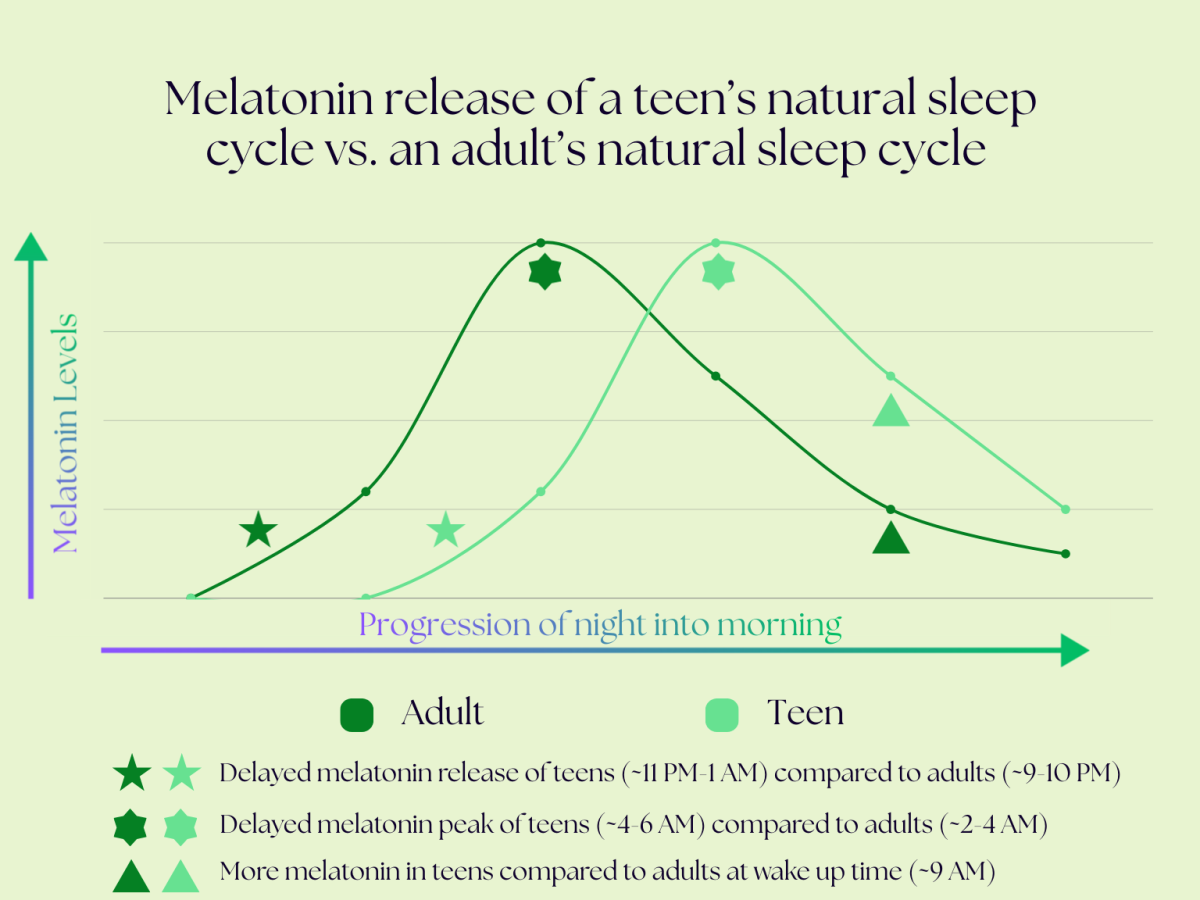
Sleep is regulated by two major systems in the body. The first is the circadian rhythm, an internal clock that influences many biological functions, including body temperature, alertness, and melatonin production. Melatonin, a hormone produced by the brain which signals it is time for sleep, remains suppressed in daylight and begins to rise only in the evening under dim light. Although this system is calibrated to roughly a 24-hour cycle, its exact timing varies from person to person — and in adolescents that cycle can stretch beyond 24 hours, naturally pushing bedtime later by up to 2 hours.
The second system is the homeostatic sleep drive. While we are awake, sleep pressure gradually builds because of adenosine, a chemical by-product of the body’s energy use. The longer someone stays awake, the stronger this pressure becomes. When we sleep, adenosine levels fall and the pressure is relieved. In teenagers, however, this drive accumulates more slowly, reinforcing the difficulty of falling asleep early and waking up refreshed.
These systems are meant to work together to provide enough sleep at the right time. However, during adolescence, the circadian rhythm undergoes a “sleep phase delay,” which postpones the release of melatonin until later at night. As a result, teenagers often do not feel sleepy until 1-2 hours after adults normally would.
Some scientists view this pattern as part of a broader process of individuation. Adolescence is a period of separation from parents and establishing independence, and the ability to remain awake later may be a biological expression of that drive, allowing teens to inhabit hours of the day less dominated by the older generation.
Unfortunately, this biological shift collides with early school schedules. While adolescents grow sleepier later, early start times prevent them from sleeping in, creating a nightly “sleep debt” that can develop into chronic sleep deprivation.
A Brown University study found that people between ages 10 and 17 reported progressively later bedtimes on both weekdays and weekends. Because wake-up times are fixed by school hours, the actual time spent sleeping shrinks through the teen years, and the gap between weekday and weekend schedules becomes increasingly pronounced.
A survey conducted by Eastside illustrates how strongly this issue affects East students. Although high schoolers are advised to receive 8 to 10 hours of sleep, 89.6% of East students reported getting less than the recommended during the school week. 45.3% get 6-8 hours of sleep, while 30% typically sleep only 5 to 6 hours, and 14.3% get fewer than 5 hours. Just 10.3% manage to get 8 to 9 hours, and no student reported getting more than 10 hours of sleep.
According to the survey, the majority of students feel the most tired on Monday, and the least tired on Saturday and Sunday. After two mornings of being able to sleep in, the return to early alarms on Monday abruptly disrupts their natural rhythm. The school schedule once again clashes with biology, leaving adolescents to start the week already behind on sleep.
Understanding the science behind teens’ later sleep patterns helps clarify that this challenge is biologically driven. The shift in the adolescent circadian rhythm and the slower buildup of sleep pressure make it difficult for many teenagers to fall asleep early and wake up for school feeling rested.
For many Cherry Hill East students, sleep is not the utmost priority the night before a big test. The consequences of sleep deprivation and traumatic memories slouching around school after pulling an all-nighter seem to get muddled as the clock approaches those fateful cramming hours.
There’s nothing an energy drink can’t solve, right?
Sleep deprivation in schools is an epidemic, meaning it is widespread and poses a concerning public health trend. According to a study by Northeastern University, 92% of high-school students are sleep deprived in some capacity. This is especially worrisome given the critical role sleep plays in brain development during adolescence, along with its other key purposes like preventing infections and rebuilding muscles.
An important factor that results in the extent of sleep deprivation in schools is the fact that students not only normalize it, but also promote it. East senior Manya Gupta (‘26) recalls noticing students using sleep deprivation as a source of competition and an indication of intelligence.
“We basically glorify [sleep deprivation], and even make it a sign that someone is a good or hardworking student,” said Gupta. “Even when that’s not necessarily the case.”
The glorification of lacking sleep is unwarranted because in reality, getting sufficient hours of rest before an exam is crucial to maintain problem-solving and critical thinking skills. In fact, it has been determined that the mental state after pulling an all-nighter is equivalent to the cognitive impairment of a 0.05% blood alcohol concentration. So, sleep deprivation is actually often counterproductive to academic performance.
While those extra hours of cramming may seem beneficial in the moment, and there can be instances where pulling an all-nighter works out in one’s favor, it is necessary to consider long-term goals. Many high schoolers find themselves caught in a cycle of procrastination where sleep deprivation becomes the norm. Therefore, getting inconsistent sleep can very easily become a daily habit, which is incredibly unhealthy in the long run.
So while getting the perfect 8-9 hours of sleep daily is ideal, the all-or-nothing mindset is ineffective in this particular discussion. Rather, students should try to build a habit of getting consistent sleep by building a time management system early on to avoid getting trapped in the cycle.
Gupta personally utilizes a system of estimating the time it takes to complete her daily tasks—whether it’s completing an assignment, studying for a test or handling some other responsibility. This allows her to allocate her work throughout the day, like finishing a task during her lunch break, instead of everything being concentrated at nighttime.
However, Gupta recognizes that sometimes things are not always ideal. Sometimes, students including herself genuinely have too much work and too little time.
“There are always certain periods where all of the tests happen at the same time,” said Gupta. “There are going to be times when it just feels like an all-nighter is inevitable.”
Instead of aiming for perfection, Gupta strives to be realistic and get as much sleep as possible throughout the school week by using her system. She encourages other students who may struggle with sleep deprivation to explore their weaknesses with time management and build their own personal approach to combating that particular flaw.
So while building a healthy and sustainable sleep schedule may seem like a long shot, it is always possible with the correct mentality. Prioritizing one’s sleep schedule now is a smart lifelong investment that high-school students can benefit from immensely.
Stress is often described as something that we feel — overwhelming thoughts, tight shoulders before a test, the constant pressure to keep up. Yes, you can absolutely feel stress, and it manifests physically and behaviorally as it is your body’s natural response to pressure. But inside the body, stress is a chemical; and especially for teenagers, chemistry behaves differently inside our bodies than an average adult.
The chemical behind stress is cortisol, a hormone designed to help humans react quickly to situations, or in other words, your “fight or flight” response. In short bursts, cortisol is useful. It sharpens your focus while also increasing alertness and the body’s preparation to respond. But when cortisol begins to remain elevated for a longer period of time, it begins to take a toll on your health, especially teenagers.
Understanding the Stress Response
When an individual experiences a stressor, which is something that causes a state of strain or tension, two hormonal systems are activated to help cope with stress. First, the sympathetic nervous system (SNS) that is a part of the autonomic nervous system, releases adrenaline chemicals like epinephrine and norepinephrine to immediately trigger the “fight or flight” response.
While adrenaline kicks off the initial alarm, cortisol supports this heightened state by ensuring you have enough energy and focus to deal with the stressor. The Hypothalamic-Pituitary-Adrenal (HPA) axis is responsible for regulating this longer phase of the stress response, prompting the release of cortisol.
For adolescents, this system behaves differently than it does in adults. Because the brain is still developing throughout teenage years, emotional regulation and stress control is not fully matured. As a result, teenagers not only experience stress more profoundly, but also for a longer amount of time.
Why Teen Stress is Biologically Different
According to research from the National Institute of Health, adolescents can experience stress differently than adults biologically. The prefrontal cortex, which helps control impulses and emotional regulation is not fully matured yet, as well as the amygdala — an area of the brain involved in emotional processing and threat detection that is highly reactive. This imbalance means that stressful situations often trigger stronger emotional responses, while the systems responsible for calming those responses are still maturing. As a result, teens tend to release more cortisol in response to stress and take longer to return to baseline levels. Stress, in other words, does not shut off quickly. It lingers.
To better understand how stress affects a high school student’s daily life, Eastside conducted a survey, examining patterns of stress, fatigue, and pressure across the school week for East students. Students were asked which day of the week they felt stressed the most, where it peaked at the start of the school week rather than the middle. 37% of East students felt that their most stressful day was Monday. High stress levels remained congruous through Tuesday (18% of students), Wednesday (21% of students), and Thursday (19% of students), before dropping on Friday (7% of students). Only less than 2% of students voted that Saturday was their most stressful day, where Sunday showed a significant increase to 17% of students reporting it as their most stressful day.
This distribution can suggest that stress heightens abruptly as academics resume after the weekend. Biologically, this early week surge represents how academic demands push students’ bodies into a state of prolonged stress that increases cortisol levels. In simple terms, consistent stress throughout the school week indicates the body’s failure to return back to normal, which could be a sign of chronic stress.
Stress That Doesn’t Sleep
Adding on, a significant amount of East students reported feeling the need to stay up late at night in order to complete their work. 39% of students answered ‘Yes’ to the feeling of having to stay awake during the night to get work done, and 41% of students answered ‘Occasionally’, leaving only 20% of students who do not feel the need to stay up late to complete assignments. This behavior sparked by pressure aligns with the biological effects of heightened cortisol.
The feeling of being unable to completely shut down suggests a nervous system that is unable to withdraw from the “fight or flight” mode. When stress takes over the body, physical symptoms like increased heart rate, headaches, muscle tension, and respiratory effects all could be a part of heightened cortisol levels.
In teens, stress can often be misinterpreted as a lack of things like resilience or time management. However, the biology behind cortisol tells us what is really going on. Cortisol is not a harmful chemical, and it’s essential for a functioning human. But during adolescence, the brain is still in a state that is not-yet mature enough to be able to fully regulate stress; that is why biology shifts the conversation away from blame and towards awareness.
Picture this: it’s 3 a.m. and you are sitting at your desk, finishing the outline for that essay due in a few hours. Trembling hands, aching neck, and shutting eyes are all conquering you. You’re fighting the message your body is trying to send, letting you know that it was time to go to bed four hours ago. You say that this is your last time procrastinating, but you’ve said that for the past 100 days. According to many students at East, this is reality.
Procrastination is usually viewed as laziness or poor time management, but science shows that there is more complexity to it. At its core, procrastination is a battle inside the brain: emotion v.s. logic, driven by how motivation works neurologically.
The brain has two key areas that play in this struggle, the prefrontal cortex and the limbic system. The limbic system is the area that controls emotions and seeks immediate pleasure, therefore trying to avoid stress. When an assignment feels overwhelming, the limbic system pushes our brains to avoid it, as it causes stress on the brain. On the other hand, the prefrontal cortex plans, makes decisions, and is responsible for self-control. It helps us think about long term goals, like future success, or a strong report card. Procrastination happens when the limbic system overpowers the prefrontal cortex.
Dopamine also plays a major role. It is a neurotransmitter, which means it is a small molecule that carries signals from one nerve cell to another. They are essential for brain function, just like how you would need a boat to cross a river. Tasks that come with quick rewards, such as doom scrolling or playing video games, cause an immediate dopamine release. However, schoolwork often has a delayed reward which makes it less appealing to the brain because it wants that reward as soon as possible. As a result, the brain naturally leans towards activities that provide instant gratification, causing an interference with long-term goals.
Motivation increases when tasks feel manageable and meaningful, so breaking work into smaller steps helps activate dopamine through smaller achievements. Connecting tasks to personal goals also strengthens the prefrontal cortex’s ability to endure. Understanding the science behind procrastination shows that it is not a character flaw, but a response that can be managed with the right strategies.
So, the next time your brain tells you “just five more minutes,” remember that small decisions are how the big habits begin to break.