
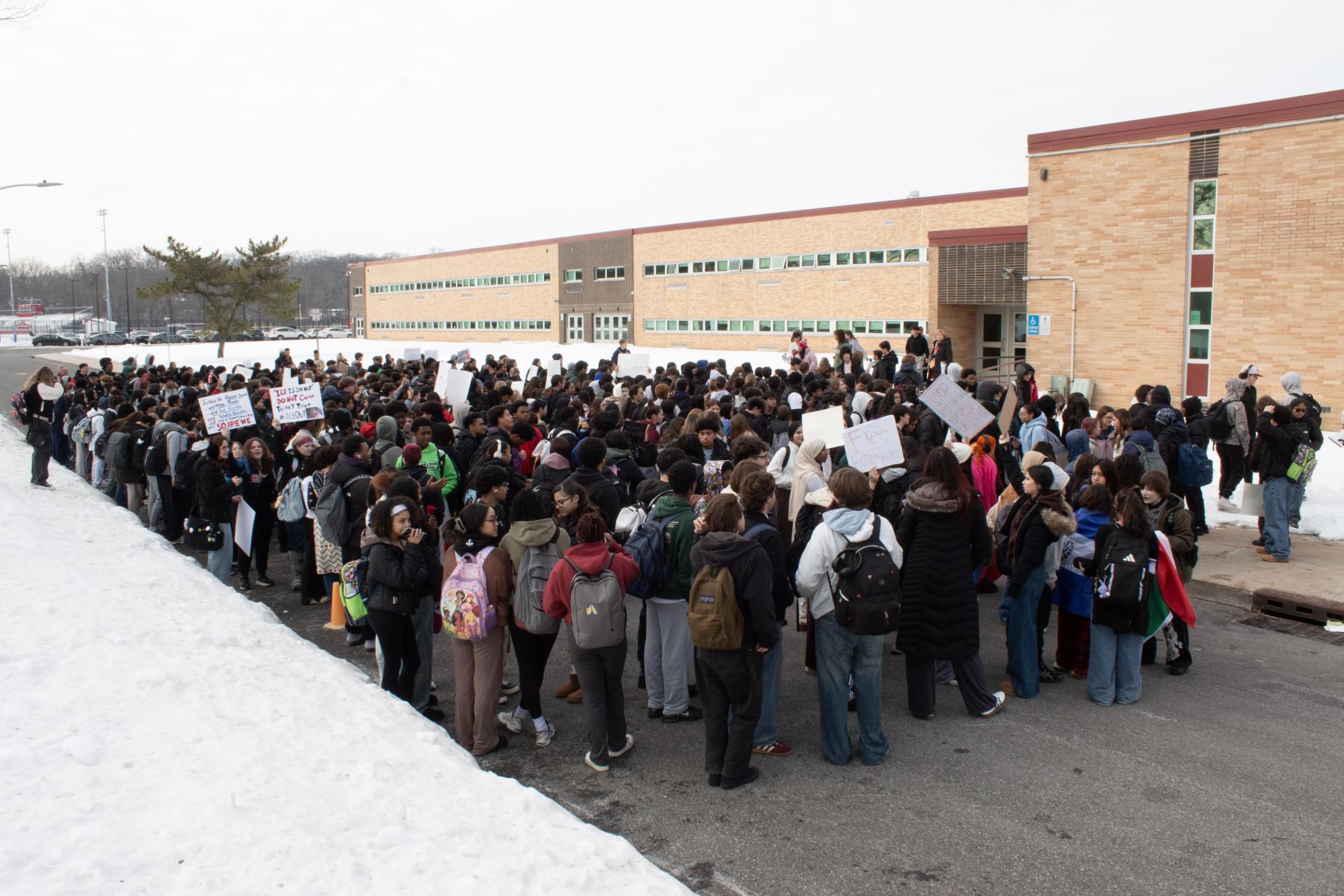

East students walk out in protest of ICE actions nationwide


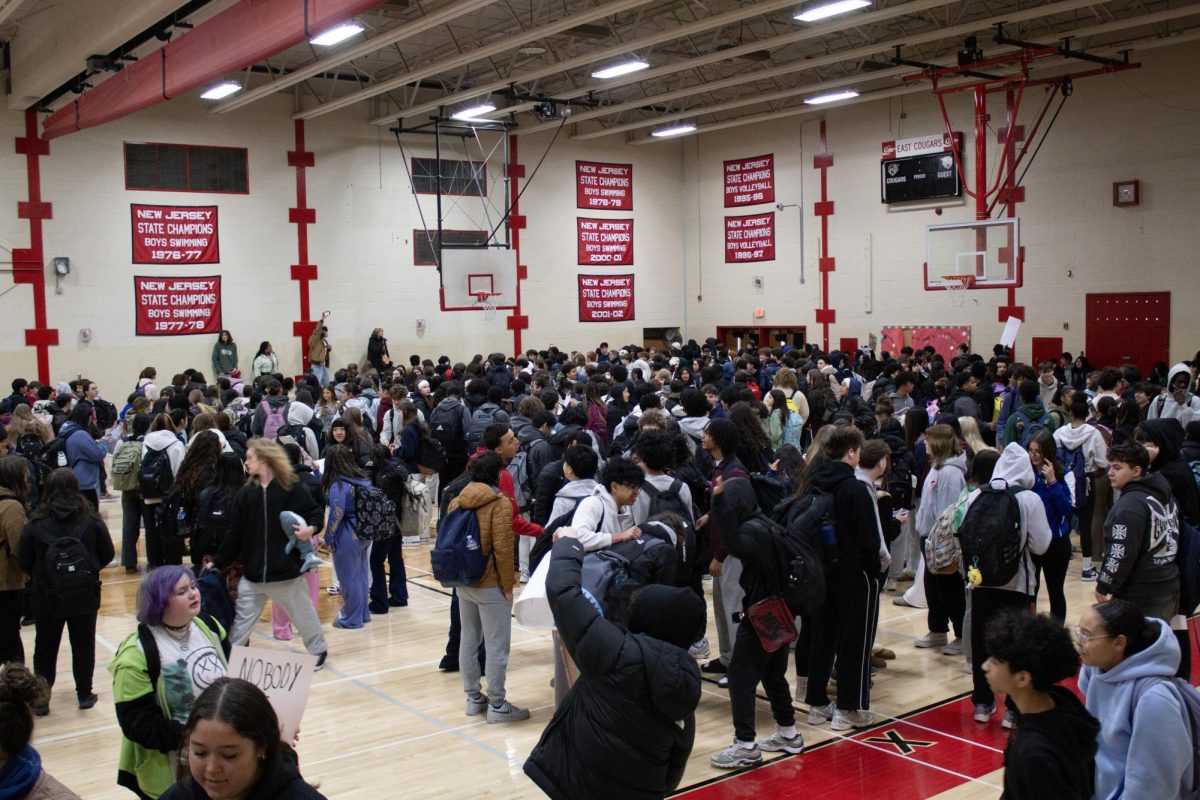
On Friday, Feb. 6, approximately 500 students walked out of classes between 9:28 a.m. and 10:31 a.m. at the East Gym in protest of the presence and actions of Immigration and Customs Enforcement (ICE) nationwide. Notably in attendance were Interim Principal Mrs. Leslie Walker, Director of Secondary Education Dr. Neil Burti, and Assistant Principals Mr. Charles Davis, Mrs. Genene Barnes, Mrs. Katherine Pereira, and Mr. Ray Robinson — all of whom directed students throughout the walkout to ensure safety guidelines were followed.
Since Monday, Feb. 2, student organizers of the protest, including Elias Ghatak (‘26), Elizabeth Zimmer (‘26), Jacob Rodriguez (‘26), and Loren Clayton (‘27), posted information on an Instagram account under the username “iceout.che” to publicly promote the walkout and its guidelines. Posts included a map of the route, details on the boundaries of the protest, and assurance that students who participated in the walkout would not face direct consequences. However, Walker did later specify that participants would still be marked absent from their B-block classes, and any students who overstepped the boundaries set by administration would face repercussions.
“This walkout is a symbolic act of solidarity. It is meant to start conversations, spread awareness, and encourage further action, not to be the final step,” one post on the account said.
The account declared the walkout’s purpose as raising awareness about ICE actions from separation of families, to immigrant detentions in unsafe conditions, to deportations that place immigrants in danger. The account also encouraged students to support beyond the walkout by self-educating with verified information, supporting legal aid organizations, and contacting representatives about immigration policies.
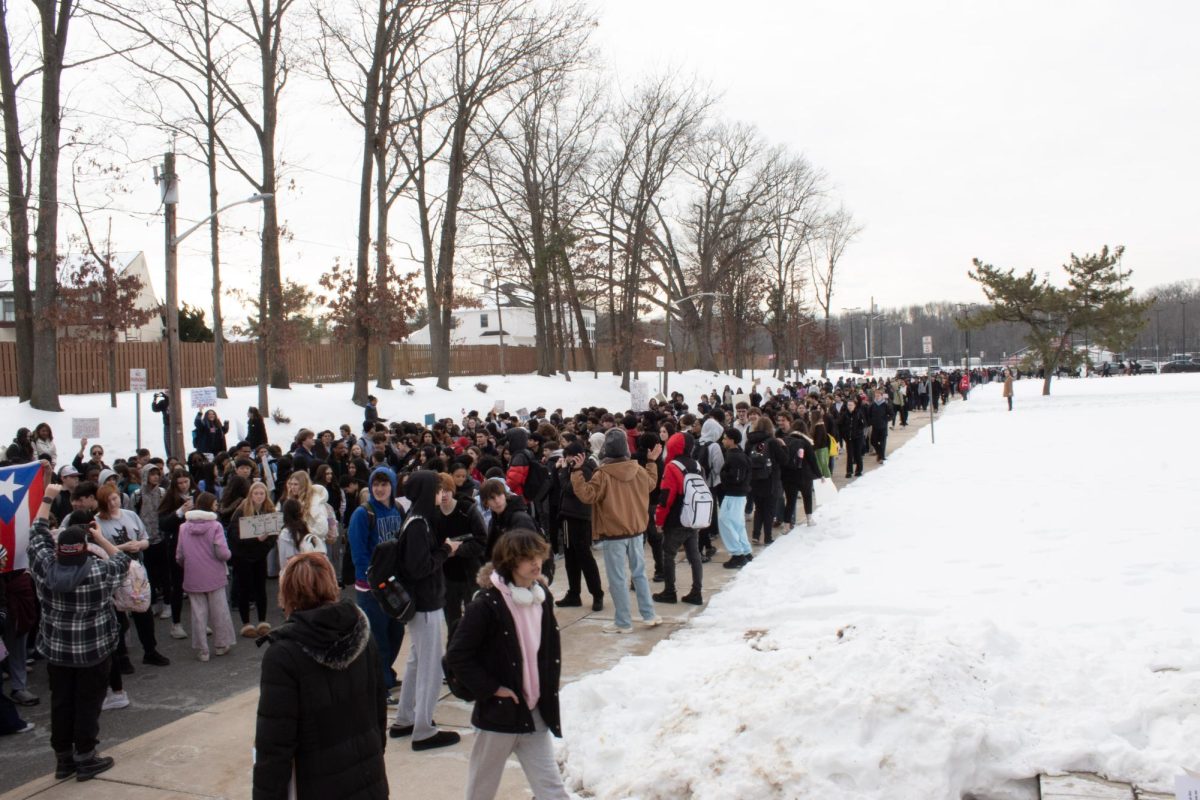
Before walking out, students gathered in the East Gym, where Walker and the four student organizers spoke briefly to the crowd about the code of conduct and guidelines for the protest. At 9:49 a.m., administrators gave permission to begin the walkout, prompting the crowd to exit the gym doors and walk around the side of the school toward the annex.
Moments after the crowd convened in front of the annex, a small group of approximately 25 protesters briefly walked past the barricade of traffic cones to the end of the street, where a campus police car blocked the road, until administrators herded them back into the main crowd.
The organizers then addressed the crowd with a megaphone, with Ghatak briefly reminding students of their First Amendment rights, before Clayton began the most prominent speech of the walkout.
“I’m the only one in my family born in the [United States]. As recently as yesterday, ICE was at Cooper River Park, the park where my 7-year-old little sister plays at — the park that is just four minutes away from my house,” Clayton said. “This isn’t just about my family. This is about every immigrant family in our community — families that work hard, pay taxes, and contribute to our neighborhoods, families who are being targeted by ICE, even in places where they should feel safe like parks and schools.”
After the crowd applauded Clayton’s speech, another larger group of approximately 60 protesters pushed past the barrier again, walking all the way to the main entrance despite warnings of potential suspension from administrators.
At 10:08 a.m., administrators began to walk the main group of students from the annex back to the East Gym entrance, and the student organizers echoed their directives shortly after. Some students deviated from the planned route, instead reentering the school through the B-wing entrance.
Simultaneously, the small group of students at the main entrance moved further up toward Kresson Road, eventually gathering on the sidewalk next to the exit of the student entrance parking lot. Protesters could be heard cheering and chanting slogans including “No hate, no fear, immigrants are welcome here” and “Abolish ICE.” Other students played music on speakers from Hispanic artists like Bad Bunny, while passing cars honked their horns both out of support and disapproval.
At 10:17 a.m., once the majority of the protesters had reentered the building, administrators funneled everyone back into the East Gym, where students remained until the bell rang at the end of the period.
Finally, at 10:31 a.m., the walkout officially ended as the protesters in front of the building reentered through the student entrance. However, throughout the lunch and homeroom periods, several small groups of students continued to walk through the halls with their signs.
“We can’t stand by and watch this happen. We need to demand accountability from all our leaders. We need to show up at every rally, every meeting, and every protest. We need to make sure that ICE understands that we’re watching, we’re listening, and we’re not going to stop fighting back until they leave the innocent people in our communities alone,” Clayton said. “If you came to this protest today because you’re scared, angry, or stressed, I’m right here with you. Use those strong emotions and channel it into something that can help better your future. Speak up, spread the word, and stay safe.”
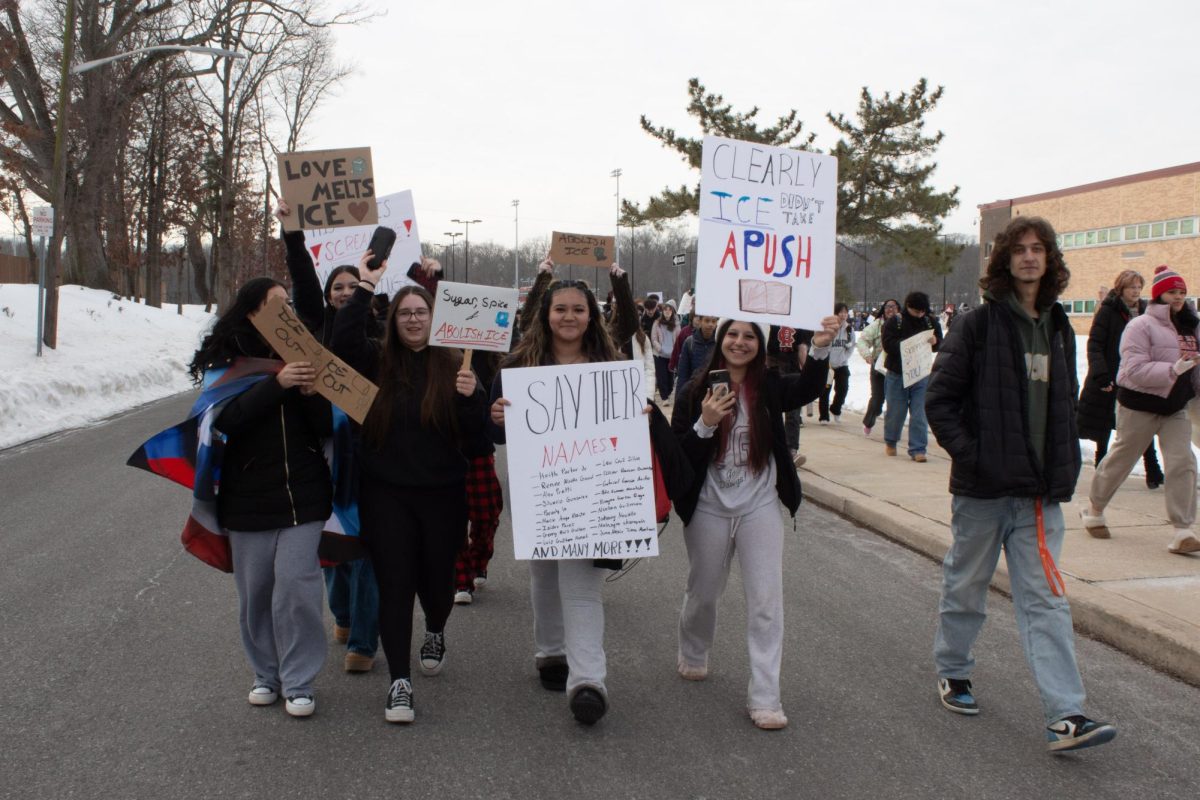
“I’m here because I hate fascism. I hate the spread of violence and terrorism across the country, sponsored by the government to allow our people to murder our own civilians for no f—— reason,” said Wolfgang Drake (‘27), a student who attended the walkout in protest of Immigration and Customs Enforcement (ICE) on Friday, Feb. 6.
The consensus among attendees was to remove ICE from New Jersey, though once Eastside spoke to individual students, it became clear that the cause was personal to everyone in different ways.
Many protesters came to support their immigrant loved ones, from parents to family friends. Whether they experienced the impacts of ICE raids firsthand or learned through the news, students shared a sense of urgency and concern.
“I’m here at the protest because both my grandparents are immigrants. This country was founded on immigrants, and what ICE is doing is absolutely horrific. They’re imprisoning children and taking U.S. citizens off the street. … This protest shows that we are not supporting ICE, and we are not staying silent,” said Sonia Motiwala (‘27).
“I’m protesting because I am Hispanic, my parents are immigrants, and this is just extremely wrong. This shouldn’t be happening,” said Camila Fortuna-Moreira (‘29).
Other students wanted to express their dissatisfaction with the government as a whole and condemn events taking place across the country.
“I came to this protest because I’ve been watching the news and seeing [people] being detained and, like Renee Good, brutally murdered. I feel like the school really needs to show its commitment towards this cause. These are human lives that we’re dealing with. So it’s really important we all just come out here and show our support for abolishing ICE,” said Erin Watkins (‘27).
“I’m at this protest because ICE is something that affects not only me but my community. I think it’s very important that immigrants can feel safe on the streets, and that people need to see the humanity in these people. The people they’re deporting are mothers. They’re children. They’re humans, and they deserve a place to live safely,” said Jaslyn Tsai (‘27).
Even though some students presumably came only to skip class, many felt that any level of participation was meaningful.
“I feel like this protest [introduces] people [and] connects them to [shared] feelings about ICE, and supports the community. Honestly, I think this protest, even if you’re just here to be out of class, helps no matter what,” said Dolcie Carmona (‘26).
“The importance of student protesting is to really just show people that we have a voice to use. … So yeah, we [need to] be out here, we [need to] open up our mouths, [and] we [need to] do something,” said Taylor Damon (‘28).
And for some students, staying behind the cone barriers wasn’t enough.
“There’s no point [in] a protest [if it’s] keeping us in the back,” said Rebecca Gross (‘29), a student who chose to march to the front of the school, even as administrators threatened consequences. “I risked suspension because A, nobody is illegal on stolen ground, and B, immigration built this country, and my family comes from Israel. And seeing what’s going on, where people are being deported for practicing their natural rights, is stupid, and that is the real issue.”
The protesters by the sidewalk faced an environment more realistic to demonstrations in the rest of the country.
“We were just peacefully protesting, putting our signs out, trying to get as much news coverage as we possibly could. A couple of news stations showed up. They recorded us. People were honking, driving through Kresson. And yeah, everybody was just showing support,” said Samuel Duarte (‘27). “We had a couple of pro-ICE people flip us off, boo at us, honk at us, but we didn’t care. We just kept protesting.”

To gain insight into the planning that went into the walkout, Eastside interviewed Interim Principal Mrs. Leslie Walker.
Walker shared that, in the days leading up to the walkout, she researched her legal rights as principal in regulating the protest. Additionally, she created a map of the route, which included specific locations where administrators would be watching. Walker even walked the route herself before the walkout to time it and write a schedule. She also had a backup plan to host the protest speeches in the annex if temperatures were too low for them to be held outdoors. Here are some highlights from our discussion with her.
Q: What did administration do to make sure this protest was carried out safely?
A: [We] listened to the leaders and what their goal was, told them what the boundaries were as far as student protests by Cherry Hill and Cherry Hill East’s policies, and then worked with them to help them meet their goal within those boundaries, because the boundaries are based on the safety that we can provide.
Q: Could you tell me a bit about the difference between what the organizers had been requesting and what was ultimately carried out today?
A: They had been requesting a longer period of time that would span several classes, and I gave them the logic of why that probably would not be realistic. … They wanted to be in the front of the school and we couldn’t allow them to do that because that’s a school policy and that is for safety reasons as well. We talked about what areas that I could allow them to be in and provide adequate safety, and then they brainstormed ideas of how they could work within those boundaries.
Q: We saw a small group of students walk to the front of the school against policy. Are there going to be any consequences for those students, and what might that look like?
A: Yes, they were told not to cross the cones. They had a boundary within it. A lot of them couldn’t hear me in the gym, understandably, but I stood at the cones when they were standing there. I said, “You may not cross the cones,” and everybody just kept passing by and passing by. … I have just sent an email to the other assistant principals and asked them to speak on Monday about it, and we’ll make some decisions together because they have insight about walkouts that I don’t have.
Q: Why do you think students should be allowed to organize events like these?
A: I think it’s part of becoming young adults. … I think when students come up with an idea that they want to act upon with passion, and if the school is able to accommodate that without taking a stance on it, … our goal is to provide safety and security. … I think that’s part of understanding, as you grow up, of decisions that you would make about any kind of demonstration or any kind of passionate topic that you have: what kind of environment you’re [going to] be in, what kind of boundaries might be set, what kind of risks you’re willing to take, and how things can work out if you’re proactive and cooperative with all stakeholders involved in helping it to happen. I think that’s lessons that can be taken into your grown up life. That’s why I think these are important. I think they learned a lot from them. I learned a lot more.
Q: What were your thoughts on today’s protest? Would you say it was a success or a failure?
A: This was the first walkout as a principal that I was leading, and I think it was mostly successful because I think the student leaders were proactive, [and] reached out to administration with plenty of time for us to understand each other. Our only role as a school was to provide safety and security, and that was made clear to them. They totally understood it, they worked within those boundaries, and they got their own word out … about what their cause was. I didn’t talk to them about what their cause was, because to me, it doesn’t matter. It only mattered if they were safe. It would have been unrealistic of me to think that something wouldn’t go wrong, so yes, I think overall it was a success.
Q: Do you have any other comments?
A: I would like to compliment the leaders of the group who came to me. They were so mature, so polite, so respectable, [and] so communicative. They did an absolutely great job, and I hope that any future issues that come up — and there’s always going to be [issues] — are handled as well as they have for them.
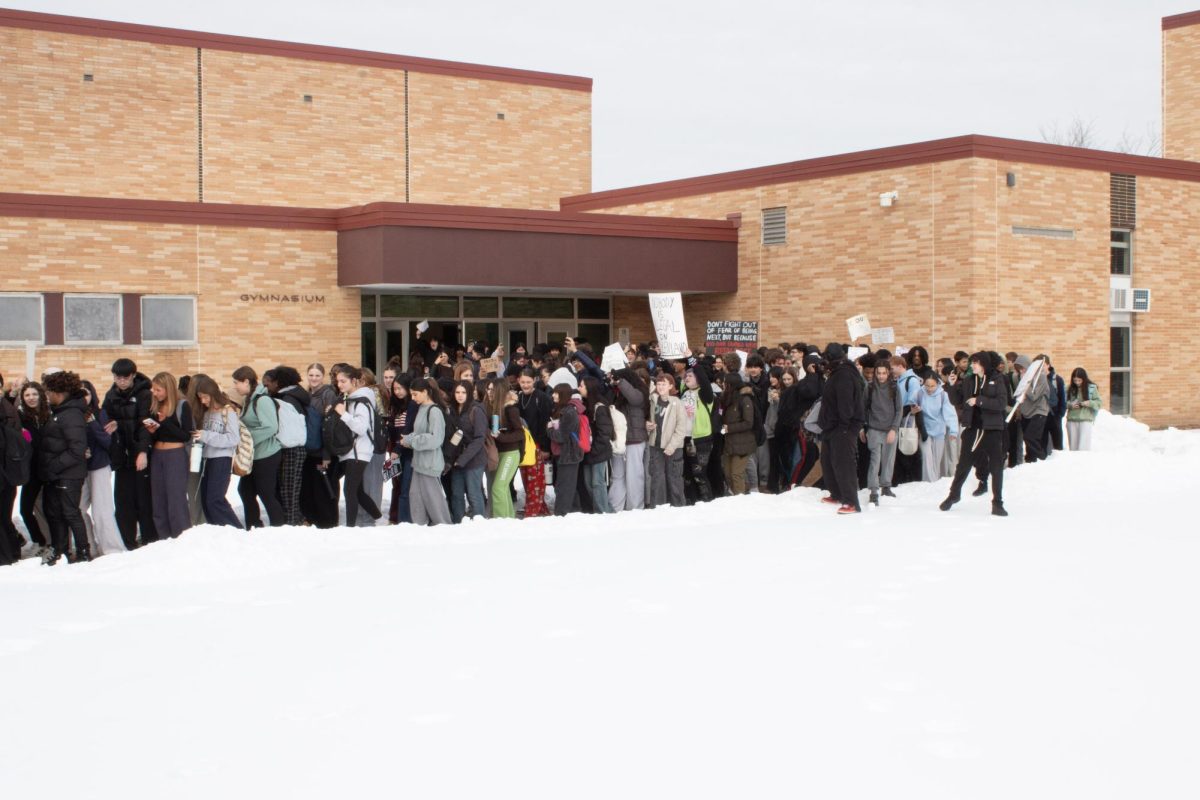
Although the walkout on Friday generated a sizable turnout, it’s not only the number of supporters that matters. Because students were prohibited from walking farther than the barricade near the tennis courts, visibility of the event was limited to those surrounding a small portion of the school building. Outsiders driving by on Kresson Road would have glimpsed at the protest for a few seconds, or even less — that is if they could have even spotted the students in their periphery. The Cherry Hill High School East administration should have allowed protestors to march to the school entrance, rather than keep the demonstration sectioned off to the side.
“We should have been able to go in the front of the building, at least on the sidewalks in the front, to show up more rather than just [in] the back of the building,” said Regan Alexandroff (‘28).
By confining the protest to the side of the building, its message only reached those already in agreement. The angry signs were visible mainly to students already in attendance, the equivalent to preaching to the choir. Protests should elicit a reaction and make people uncomfortable — because that is the only way to achieve change. If no one is unsettled, what is the point of demonstrating?
Several students echoed this sentiment.
“I feel like if we were in the front, where the cars could see us, it would send a message to the other people. I feel like we were only doing it for our school when we should be doing it for everyone,” said Chloe Barnes (‘28).
Indeed, when students marched to the school entrance, in full view of the busy street, people noticed. Yes, there were cars honking in disapproval, but there were also news trucks interested in capturing the event. Had students been allowed to demonstrate their support to the wider community, rather than remaining within East’s bubble, the protest’s message could have reached beyond the parking lot.
Click on the interactive dots to view the timeline of events.
John • Feb 24, 2026 at 11:42 pm
To Lisa, the clearly uneducated lady. The school is not teaching the students politics. If you read the article, then you’d know this was a STUDENT led protest. Are you aware of how many people in Ice detention centers have NOT committed a crime? Take a wild guess. It’s 93%. If ICE is going after illegals, then why did they murder 3 (and counting) US citizens? If ice is going after illegals then why did they hold a 5 year old trying to get home? ICE is not protecting American citizens. Funny that you talk about rape and sex trafficking, when that is EXACTLY what Trump has been involved with! The same president that you support. You are too ignorant to see the unjust actions of ICE agents because you are privileged. Thankfully these children are the future, so they can stand up against discrimination and idiocracy. You know this administration is really messed up when even highschoolers are protesting. Protecting children also means teaching them to think critically about power and policy, which you CLEARLY should too.
M Farrar • Feb 9, 2026 at 11:16 am
Good Job, East Students. Keep on standing up for what’s right.
loren • Feb 8, 2026 at 2:46 pm
hi! im loren, one of the organizers. thank you so much for publishing this story as well as covering my speech! my heart aches for those who are currently in detention camps, those who have been detained and deported without due process, and those who have lost their lives due to ICE. we all deserve to be in america, even if our president doesn’t agree. ABOLISH ICE
sage • Feb 7, 2026 at 4:24 pm
hi! i’m the person who led everyone to the front of the building and out of the boundaries. my name is sage kobb and i don’t regret a single part of it and i made sure everyone had safely made it to the front, ignoring Mr. Davis yelling and chasing after us saying “you’ll all be suspended”. i have not been suspended, and even if i am then i really do not care. this isn’t politics, it’s human rights.
Lisa • Feb 7, 2026 at 2:17 pm
It’s not the school’s place to teach our children politics and to disrespect authority Especially the law. Did they teach these children that ice is protecting the people from illegal’s ( mostly criminals, gang members) that were aloud to come in to our country over the past administration. Do our children realize that is where the drugs come from that kill their friend , family etc .Rape and sex traffic children . Please be careful what you are allowing our children to learn . Remember they are just children our future.
Leonard • Feb 7, 2026 at 11:07 am
I was one that went to the streets, part of the first 6 people to do so. They threatened suspension and I said “ok then, suspend me for carrying out my first amendment right.” As the crowd grew bigger we realised they weren’t gonna suspend us all. We went further and they kept saying “turn back or else we’re gonna suspend you” it had just become an empty threat. We weren’t going to stop because of some empty threats.