

Celebrations and controversy surrounds graduation season


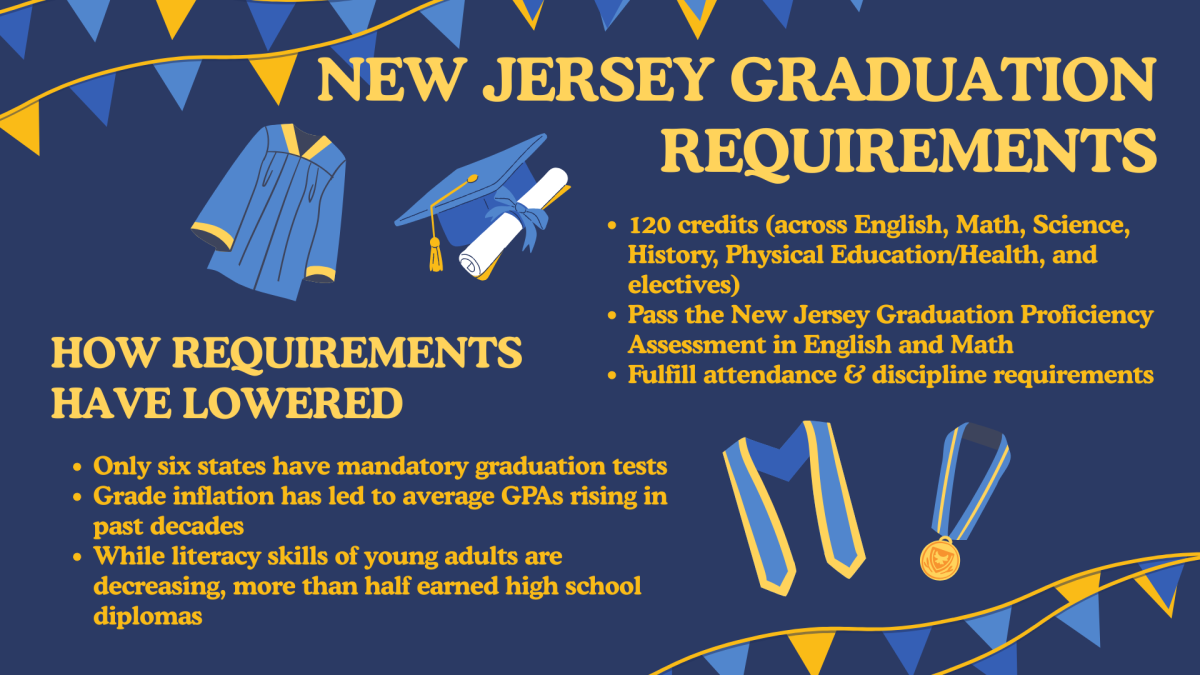
At Cherry Hill High School East, students need a minimum of 120 credits to graduate. The requirements are as follows: four years of English, Physical Education and Health; three years of Math, Science and History; one year of a world language; along with electives like Financial Literacy, Visual and Performing Arts, 21st Century Life and Career Skills and African American Studies. Students are also required to pass the New Jersey Graduation Proficiency Assessment or qualify through alternate pathways, such as receiving above a certain score on the SAT or ACT.
On paper, those requirements may seem like they are enough. However, across the country, the current graduation requirements are proving insufficient at preparing students for life after high school. Recently, videos of seniors at Preparatory Charter High School, a college prep school in Philadelphia, have gone viral online. In them, a student asks his classmates to read sentences like “She wore a silhouette of clothes that were extraordinary but somewhat gauche” and “The colonel asked the choir to accommodate the governor’s schedule,” but most severely struggle with reading and comprehension. As the clips quickly spread online, a crucial question has become the center of debate: what exactly does it mean to be “ready” to graduate?
Beyond whether students can complete required credits or pass standardized tests, the discussion focuses on what those requirements can actually guarantee in practice. While different for each, high schools already have structured graduation pathways that, in theory, should follow academic progress over four years. However, concerns persist about whether students are fully understanding and absorbing the material behind those requirements. A student can meet all formal requirements and earn a diploma, yet still struggle with foundational skills like reading fluency, vocabulary or basic comprehension. Because of that discrepancy, the worth of a high school diploma becomes diluted.
A potential cause of this gap is that graduation requirements often cause completion to be mistaken as an indication of mastery. This directly correlates to how differently “success” can look depending on how it is measured. Because schools are heavily evaluated by graduation rates, there could be added pressure to ensure students graduate on time, creating issues like grade inflation. Thus, while high graduation rates may seem positive, they do not always accurately reflect students’ readiness.
The viral videos from Philadelphia do not represent every student or every school, but they have contributed to an important discussion about whether current graduation requirements are sufficient in preparing students, and what that says about the value of a high school diploma itself.
After the Class of 2026 receives their diplomas onstage at Temple University on June 18, they will gather one final time at Cherry Hill High School East — not for a final exam or assembly, but to celebrate the end of high school. Lasting from 10 p.m. on the evening of graduation until 4 a.m. the next morning, Project Graduation is an annual event held for East seniors, providing a supervised, alcohol- and drug-free place to relax and have fun after graduation.
Tickets cost $20 each and are sold at all major Senior events such as the Yearbook Signing, Skating Party and graduation practices. The event includes food, games, prizes and entertainment. Project Graduation for the Class of 2025 included activities like face-painting, board and card games, inflatable games and karaoke. Every student also receives a gift bag, and grand prizes are drawn at the end of the night.
“All of the stress of school and graduation is over, and it’s just a fun time,” said Mrs. Holly Sassinsky, the Director of Student Activities at East.
Although Project Graduation is a program offered at many high schools nationwide, the event at East is organized entirely by the Parent Teacher Association (PTA) and volunteers, who help set up, staff and fund the night.
“We provide the space, but they have been working on this and fundraising for it for years,” said Sassinsky. She emphasized the planners’ dedication to making Project Graduation a valuable experience for seniors. “Realistically, it costs them more than $20 per student. Every student is going to get a prize, and some of the grand prizes are worth over $1,000.”
Originally started as a statewide initiative in Maine, Project Graduation provided an alternative to traditional drinking events during commencement. Nearly 1,000 children under the age of 21 die in preventable tragedies during prom and graduation season, according to the National Highway Traffic Safety Administration. Efforts like Project Graduation keep teenagers safe while allowing them to relax, eat, and party with their friends.
Cherry Hill High School East graduation speakers are decided by a two-round selection process. In the first round, candidates anonymously submit their speeches to a committee of faculty members. If the committee likes a candidate’s speech, they are invited to present it to the committee. The best of these speakers speaks on graduation day.
The purpose of the anonymous primary selection round is to prevent bias. If someone in the committee has a strong relationship with the author of the speech, it risks the writer having an unfair advantage over other students. Furthermore, anonymity is supposed to guarantee that the speech itself is what is considered, not the student. The untraceability is meant to ensure that the selection process is a scrutiny of a speech’s content rather than the merit of its author.
However, this first-round selection method is less than ideal. It disregards two important factors in a meaningful speech: its presentation and the credibility of its speaker.
When speaking in public, the manner in which the speech is delivered matters just as much as its content. People may not remember the exact words of an address, but the way in which it is expressed resonates with them. Saying a speech requires the orator to be charismatic. If the speaker is lame or timid, the audience won’t follow them. A speech’s strong writing is ultimately pointless if the speaker can’t properly articulate it.
Although the second round of speech selection assesses the qualifiers’ speaking capabilities, the anonymous first round can unintentionally eliminate strong public speakers. Advancing to the second round of selection relies solely on the candidate’s writing talent. Consequently, the best public speaker in the school could be outperformed by a stronger writer who is a worse speaker, preventing them from ever getting the opportunity to demonstrate their talent. Since the first round overlooks a crucial aspect of oratory skill, the curated pool of candidates in later rounds may not represent the best speakers. Furthermore, it is far easier to revise someone’s writing than it is to train them to speak enthusiastically and coherently in front of hundreds of their peers.
In addition to its oration, a speech benefits from a distinguished person delivering it. A graduation speech would be far more meaningful if it came from a student who has been actively involved in school affairs throughout their high school experience. Whoever is delivering a graduation speech should be someone who is exceptionally active in the school community. The current, anonymous, first round of speech selection can allow less accomplished students to move on over students who have done more during their East experience.
To correct the speech selection process, the first round needs to be overhauled. Instead of judging based purely on the text of the address, the applicants should be required to submit a video of themselves presenting their speech. A video-based process makes the first round of judging a more accurate assessment of public speaking skills, while still emphasizing the content of a speech. Furthermore, each candidate should attach a short paragraph about how they have been involved in the school community throughout their time at East. Candidates do not need to have held any leadership positions, but they should demonstrate continuous involvement in prominent school events. This system is a more accurate, balanced evaluation of a candidate’s public speaking skills and writing capabilities.