

Community Asian markets: Building connections and bridging gaps


“民以食为天” (Mín yǐ shí wéi tiān) is a Chinese proverb that, in short, means that food is important—an utter necessity for humankind.
While this lesson could be viewed as physiological, a simple statement of the nourishment needed for survival, it truly hints at something greater: food’s ability to help one live life to its fullest. Cuisine, and the connection and fulfillment it brings to relationships, is a vital part of Asian culture. Traditional dishes allow communities to bond and future generations to learn from those who came before them.
This form of connection is unique but delicate. Without a means of strengthening one’s bond with the past, vital culture can be lost in the fast nature of 21st-century life, as well as the physical geographic barrier of living away from one’s origins. In the United States, social media and technology can take precedence over familial bonds and traditions, reducing the strength of cultural ties through decreased assimilation.
Asian markets are deemed cultural and community hubs, in the sense that they give one the chance to slow down and take in the moment—whether it’s shopping with one’s grandmother as she tells childhood stories or sharing the vibrancy of Asian cuisine with a group of friends.
Furthermore, Asian markets serve the diverse demographic of South Jersey. The large Asian population in Cherry Hill and surrounding towns is given a place to feel at home, creating relationships within their own culture and community.
On a broader scale, markets encourage increased understanding of Asian culture. People of all walks of life are able to shop, dine and learn more about traditional customs and cuisine, serving the diversity of South Jersey and promoting cultural awareness.
________________________________________________________________________
The following three impacts of Asian markets in South Jersey stem from real stories of real people who dined at H Mart, the US’s largest Asian supermarket chain, on Thursday, April 24. Through their personal experiences, the true culture and importance of food to the Asian community are revealed, extracting life lessons from past experiences and fueling present and future moments of connection.
________________________________________________________________________
Megan Horwitz (Korean) – Connecting with the community
Megan Horwitz (‘94) currently lives in Haddonfield, New Jersey, but she was born in Seoul, Korea. She later immigrated to the United States, where she attended Cherry Hill High School East.
Food is an important part of her origins and the traditions she hopes to carry on to future generations. Horwitz enjoys cooking and experimenting with new dishes. However, beyond creativity and flavor, food holds a greater importance to Horwitz; it allows her to connect with the life she has left behind while also creating bonds with the Asian community in South Jersey.
“[Asian markets are] really important to me because [I love] having a place where we have the ability to buy the foods that we like to eat,” said Horwitz. “And also, to come to a food court like [at H Mart] to be able to get… whatever you want is really important.”
Her daughter, Jocie, has felt the impact of Asian markets and overall authentic cuisine on her cultural identity firsthand. She enjoys eating her mother’s homemade fried rice, and has begun to gain an appreciation for Korean food herself.
Asian markets act as a lively center of food, conversation and tradition. Horwitz values the sense of connection that she and her daughter experience stepping foot into these cultural hubs.
“It makes you kind of feel like part of a community,” said Horwitz. “It’s really cool to be closer to our roots.”
________________________________________________________________________
Frank Lovello (Italian-Korean) – Bridging the cultural divide
Frank Lovello’s story starts before he was even born.
His parents met while his dad was stationed overseas in Korea during his tour with the U.S. Army. He met Lovello’s mother, who was from Korea, and they fell in love. His mother immigrated to the United States eight years before Lovello was born. They raised him to value food and family.
“[Food] just brings back home,” Lovello said. “It brings back memories with me and my mom.”
Throughout his youth, his mother would make homemade kimchi and dumplings, childhood staples that nurtured Lovello’s connection to the Korean side of his biracial background. In fact, they strengthened his appreciation for his roots, granting him a source of cultural pride, despite growing up in the U.S..
“I had the best of both worlds: my dad being from America, my mom being from Korea,” said Lovello. “I feel like when I was younger, I was definitely more in touch with my American side, and the more I [grew] up, I’d become more in touch with my Korean side.”
As Lovello aged, Asian food provided him a platform to build relationships with others, whether they shared the same background or not.
“My girlfriend,” said Lovello. “She’s not Korean, [but]… I feel like we bonded together over Korean food.”
Lovello also noted the role food played in uniting his Korean church group, as they would join together for a meal following their fellowship. Asian markets, as a source of such groceries and Asian meals, act as an avenue for continued connection, allowing easier access to the food that allows Lovello to bond with his community.
“I feel like food just brings a lot of people together,” said Lovello.
In terms of carrying on his love for food and Korea that childhood dishes ignited, Lovello takes such a goal to heart.
“I would love to preserve the culture that my mom brought over to America for me and my future kids and, you know, my future family,” Lovello said.
________________________________________________________________________
Hope Doms (Italian-Korean) – Listening to the past, calling to the future
Hope Doms came to H Mart after a busy day of styling the hair of East students for Junior Prom at her Marlton hair salon, Ware Studio Salon. To unwind and spend time with her daughter and mother, she enjoyed a meal at the bustling Asian market that “kind of feels like home…. when [she] walk[s] around and see[s] familiar people from [her] background and just from the Asian community.”
Doms’ mother, Tammy, is from Korea, and they have been wanting to return and connect with their roots. However, traveling has become increasingly difficult as Tammy ages. Asian markets act as a medium that allows Doms and her daughter to learn from Tammy and her past in Korea, passing such culture on to future generations through authentic cuisine.
“I just think having the food and the culture here just brings everything together,” said Doms. “And it just makes people at home.”
Doms recalls childhood memories in which she would watch her mother “sit on the floor, and …have gloves on and make the kimchi.” Tammy also crafted handmade dumplings in batches of 200-300.
Today, Doms and her daughter, who loves kimchi, are learning how to cook the traditional dish from Tammy. Though they noted that the process was time-consuming, their family hopes to pass on vital aspects of Korean culture in South Jersey. By learning from the past, Doms, her daughter and Tammy are able to live their best lives in the present: eating cultural cuisine, going to Asian markets and connecting with the diverse population around them.
“We have a lot of culture and diversity here,” said Doms. “So I just think it’s nice to have a little bit of everything. That’s why I love this area so much.”
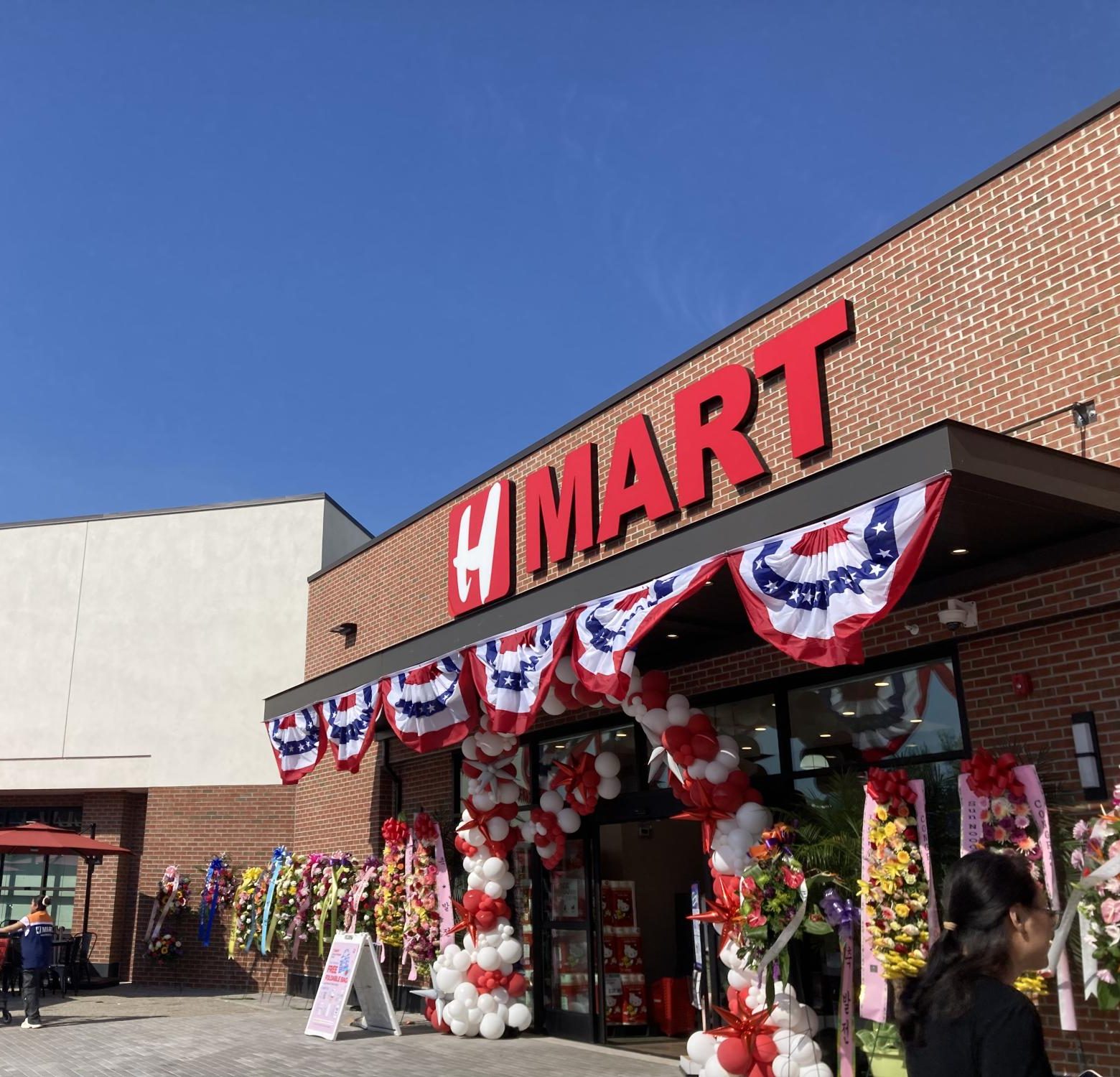
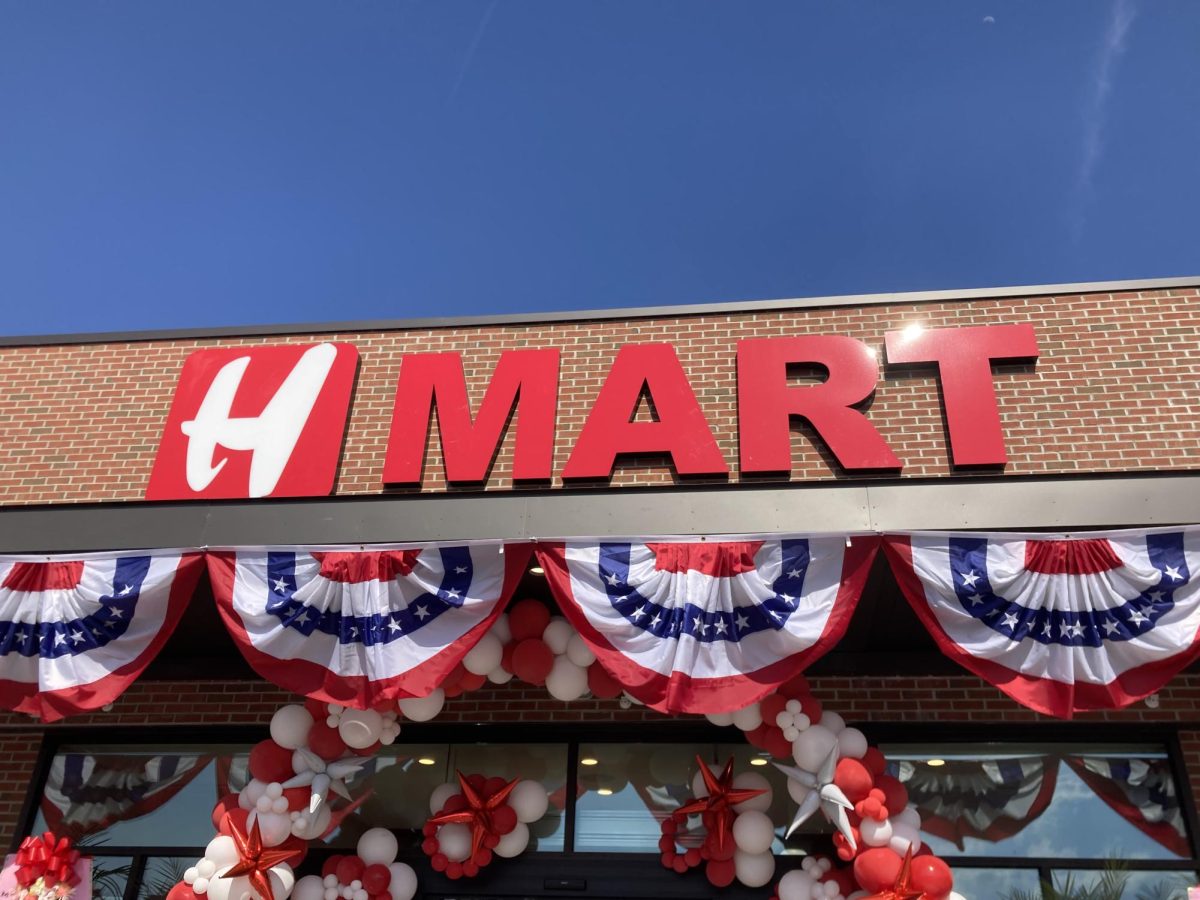
H Mart, an Asian-based supermarket chain specializing in Korean items and long-term business in Cherry Hill, reopened its doors after 18 months of renovations last Thursday, April 23, introducing an added food hall and a remodeled supermarket and retail section. These new expansions have drawn significant public traction, signaling the reestablishment of a hub for Asian culture in the community by bolstering accessibility to traditional foods and supporting the growth of six Korean businesses through aforementioned additions – Kyodong Noodles, Daily Seoul, Mirim, The Dak, Dduk Dabang, and Tiger Sugar – and a Paris Baguette location, a bakery-cafe chain.
“We are excited to be part of the newly renovated H Mart’s grand opening,” Kyodong Noodles wrote in a statement to Eastside. “It is exciting to see our diverse community that trek here, both near and far, to come try our food and also to immerse themselves in the Korean grocery market.”
The renovation project began in early July 2025, sustaining the construction for over a year during which its completion date had remained unclear.
“We actively worked on getting this location opened for the past 6 months with lots of preparation of gathering supplies, produce, and getting all the logistics down coordinating all of that with H Mart,” wrote Kyodong Noodles.
In light of its closure during this period, thousands of community members had lost a valuable center for Asian staple foods. Many were forced to resort to longer drives to purchase the produce necessary for customary dishes.
“We get a lot of our groceries from H Mart because we make cultural dishes,” said Johanna Kang (‘28), who is Korean. “So we ended up going to an H Mart, like, an hour and a half from our house in Philadelphia… It was hard for my grandma because my grandma… only makes Korean food at home. That’s kind of the only thing she eats.”
Considered one of the largest Asian market chains in the U.S., the business had established a presence in Cherry Hill as early as 2001. Prior to said renovations, H Mart had operated solely on a singular floor – the lower level of its two-story building – where it served mainly as a supermarket. The newly-added upper level, which is now the food court, was previously home to a variety of several smaller businesses, now cleared to make room for the new restaurants in H Mart’s food court.
For H Mart, the restaurants included in its renovations, and the community it surrounds, this marks the growth of a great cultural center, inducing much anticipation prior to opening.
“It’s comforting to see our food and have easier access to ingredients we may need for food that we make ourselves,” said Jennifer Ngo, a 29-year-old Chinese-Vietnamese woman who was one of the many visitors from across the South Jersey and Greater Philadelphia area to enter H Mart on re-opening day.
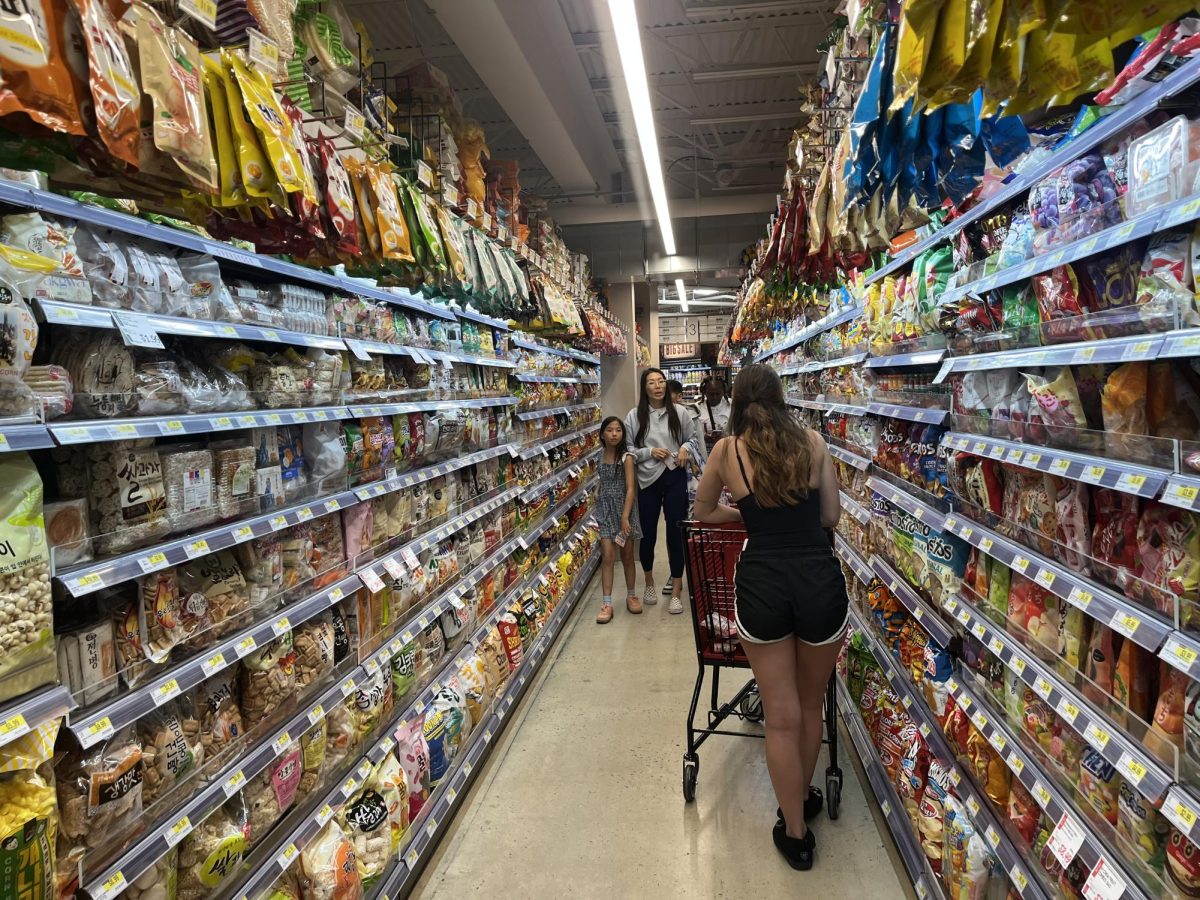
Amongst the expansive grocery store and food hall, the renovated H Mart also features an arcade, snacks, home decor, stuffed animals and even Korean beauty and skincare products. New additions add dimension to the shopping experience, providing a hub that values variety and accessibility. However, above all, H Mart continues to foster a means of cultural connection both intergenerationally and interculturally.
“Asian food is obviously really familiar to us,” said Troy Okazaki, who is Japanese, referring to himself and Anita Tan, a Chinese woman with whom he was sitting. “So it’s comfort food for us… It’s good to be here in a place where everyone else is here for a similar thing and we all can kind of bond.”
Red lanterns, packaged persimmon and tiny wine-colored mangosteen are accompanied by stacks of spicy shrimp crackers. Calmness is present within the stores; there aren’t people fighting for items or grabbing the last of a snack before it vanishes. Hung Vuong Food Market’s wide variety of produce, snacks, prepared meals and other cooking ingredients allows for a full immersion into Asian culture. This market is located in Hung Vuong Plaza, a center of Asian community and food, and its best part is that most of the places in it are run and function as Asian shops.
Claire Li (‘28), coming from a first-generation Asian American family, shared her appreciation for the cultural experience that Asian markets in Cherry Hill provide.
“Because you have a center where you’re selling all of these important cultural foods, you’re not only giving people who already have that culture, like Asian people, a chance to embrace that culture, but you’re also giving the opportunity for Asian people to share that culture,” Li said.
Within the plaza, there is the classic Kung Fu Tea, which acts as the main bubble tea and drink-oriented place in the shopping center. At Hung Vuong, customers can eat traditional Vietnamese pho, spicy Cambodian noodles or piping hot ramen, all within a one-minute walking vicinity. Brother Seafood Restaurant stands out because, along with the traditional dumplings, they sell cold jellyfish, congee, fried rice with salted fish and other Chinese dishes that aren’t found at most of the places in the Cherry Hill area.
Huong Vuong Food Market and the shopping center surrounding it encompass this idea: people who have never delved into divine flat egg noodles and crispy, salty turnip cakes have it readily available to them in all different forms. And for a community as diverse as Cherry Hill, this is especially important in the sharing of culture.
“When you have an Asian market, it’s not just Asian people that go there,” said Li, “there [are] also people from other ethnicities and cultures that can go there and buy that food, and try that food, and experience that culture.”
Hung Vuong Plaza is located at 1447 Brace Rd, Cherry Hill Township, NJ 08034.
Bryson Liu (’26)
For Bryson Liu (‘26), food was never just something to eat.
“I think [food] is a way to show that my parents show love for me and my siblings,” said Liu, “because they show [by] how much they cook and make food for us.”
But, this understanding didn’t come all at once.
In his sophomore year, his father bought the business, stepping into a role that was not entirely unfamiliar after years of helping at Liu’s grandfather’s restaurant. When YouCha had re-entered business under the Liu family, however, it had marked a new chapter of work life and learning. Now, Liu tries to help out once a week, like his older siblings had done.
This was only a part of what Liu was learning. In the early days of the restaurant, when the business had moved slowly, Liu noticed that what brought customers back wasn’t always the food or atmosphere. It was his father.
“He would always make sure that the customers, when they left, were full [and] had all their needs provided for them,” Liu said. “He would also give out free water bottles sometimes when it gets really hot outside, and he would talk to the customers a lot. The customers would come over just to talk to [them].”
In these moments, Liu began to understand that running a business, as hard of a work as it was, was about care. Seeing that balance between hard work and kindness has left a lasting impression. Now, Liu carries those same values into his own life and the way he approaches his own relationships.
“I understand that sometimes my friends are really busy, [and that] even though they’re busy, they still spend time with me,” said Liu. “I love sharing food with my friends, and that’s, kind of, my way of showing my appreciation to my friends and people that I care about.”
At YouCha, food has always been something more. And for Liu, it was a way to build connections, express care and communicate appreciation in a way that has carried far beyond countertops.
YouCha is located at 1601 Kings Hwy N Suite 200 in the Ellisburg Shopping Center.
Phoena Ke (’29)
Throughout her life, restaurant life had been something Phoena Ke (‘29) had grown accustomed to. From her cousin’s restaurant in Philadelphia to her parents’ own restaurant, Samurai Hibachi, the fast pace and steady presence of hard work have been something that has undeniably become an integral part of her life.
“I get to experience what it’s like working at the front desk, or serving,” Ke said. “I can just be in our area and have an experience like being in [at] the front desk [and] telling people that.”
But despite how natural this environment feels, sharing this part with others has not always been easy, and instead has been one of hesitation that all started with what her mother told her long ago.
“My mom told me that she [once] told somebody that she owns a restaurant, and then they started looking at her [weirdly],” said Ke. “After she told me that, I was like, if I tell others that [we] own the restaurant, they would think that I’m poor.”
The comment has continued to linger; what had once been a simple fact of her life has become something more complicated, shaped by what others think of her family.
“I do find myself telling [fewer] people that I own a restaurant,” said Ke.
At the same time, Ke has had struggles reconciling those assumptions with what she knows to be true, at least for herself and her family’s work. To her, running a restaurant was like any other occupation. And, when people gather round for food at parties and excitement replaces assumptions, it isn’t shame that fills her, but pride in her family’s work.
Having undergone this experience juggling these perceptions, Ke has broadened her perspective in how she treats others as well.
“I don’t think it’s just restaurants,” said Ke. “I think you shouldn’t judge a person by [their job]. People who are nice to people can come from a bad place or something, or the meanest person can come from a nice place – you just have to judge the person, not what they’re surrounded by.
And for Ke, this is what everyone should try reflecting universally.
“You should see it for yourself, because you need to give everybody a chance,” said Ke. “That’s why I think it’s important to judge from what you think they are, not what others think they are.”
Samurai Hibachi is located at 646 N Delsea Dr in Glassboro.
Irene Dong (’26)
Since 2018, Irene Dong’s (‘26) family has owned multiple sushi restaurants – the first in Haddonfield, and now along Marlton Pike at Mr. Sushi, All You Can Eat. But what began as an opportunity – an expansion from the former – quickly became the center of her family’s life. By age nine, Dong had already stepped into the fast-paced flow of business as a waitress and a cashier.
Having to juggle several responsibilities at a young age, Dong quickly grew more independent – especially when her parents couldn’t be present much due to the restaurant. This absence was felt, even if it were minor.
This experience at a young age has shaped how she approaches school and responsibility.
“I know most parents are very, very, involved with their children’s school life,” Dong said. “But personally, for me, I feel like I don’t really bother to put that burden on my parents. I like to try and handle things by myself before talking to other people.”
Her parents’ experience further deepened this mindset. Without the chance to pursue higher education, they led a life built through restaurant work and, to a degree, regret – regret that, with the wishes of her parents, pushed Dong to aspire to move beyond.
Hearing about this past, Dong has since adjusted the way she perceived her education and future.
“I had to be more responsible and take my education seriously so I wouldn’t have to work at a restaurant and own one in the future,” said Dong, “because I think my parents stressed that idea to me about how working and owning a restaurant can be very difficult at times.”
This difficulty had become especially apparent during the COVID-19 pandemic, not just in what she saw in her parents, but what she, herself, had gone through. When they kickstarted their business during online school after the pandemic closure, slow business meant that Dong’s entire family had to step in completely.
“During quarantine… there was no business,” said Dong. “Once quarantine was lifted, we started getting the business back together… me and my brothers had to stay at the restaurant the whole day with our parents to help out, since it was just us, and we couldn’t really hire any other employees because of COVID.”
Through those long days, Dong became more aware of the true weight of the work, all the while beginning to understand how other people viewed her family’s line of work.
“When people first ask me what my parents do, and I tell them we own a restaurant, I think their first response is always like, ‘Oh, that’s so cool,’” said Dong. “But I do feel like people should know more about what the struggles may be of having a family that owns a restaurant too.”
And these differences – stepping into the bustling workplace early, having to balance responsibilities, and working tirelessly hours when others were attending online school – made her all the more set apart from her peers.
Since then, Dong has grown a lot as a person. What has once been isolating has become a connection with her parents, she could understand more comprehensively, and a method of communication.
Looking ahead, Dong hopes to pursue the opportunities her parents did not have by becoming an occupational therapist. But, even as she looks to move towards a new future, completely different from that of her parents, the lessons she’s learned still remain – that of responsibility and hard work based on the understanding of what her parents had built, and the sacrifices it took to build it.
Mr. Sushi, All You Can Eat is located at 2117 Marlton Pike W in Cherry Hill.